Why the Same Patterns Appear Everywhere in Nature
Across nature, biology, and ancient design, the same geometric patterns repeat. Modern mathematics did not invent this structure — it revealed it.
From 30,000 feet, the coastline should be simple.
A boundary. Land on one side. Water on the other.
But it is not simple.
The closer the view, the more detail appears. Bays open into smaller bays. Headlands fracture into smaller points. River mouths split into channels that divide again before reaching the sea.
What looked like a clean line becomes something else.
And the strange part is this: the detail does not stop.
Measure a coastline with a long ruler, and the number is shorter. Measure it with a smaller ruler, and the number grows. Use a finer instrument, and the length grows again.
The coastline refuses to settle into one final answer.
the longer the coast becomes.
That should feel like a puzzle.
Because it is.
And coastlines are only the first clue.
The Pattern Appears
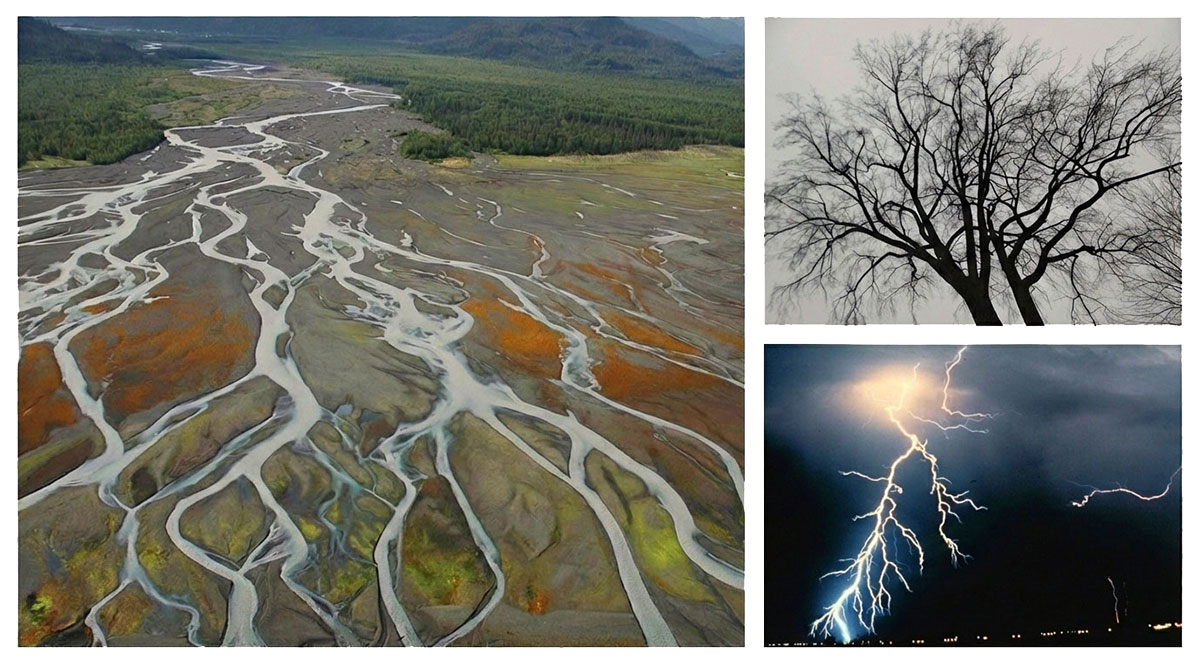
The same structure appears in river deltas.
Water moves downhill, slows, drops sediment, and divides. Each new channel faces the same pressure, then divides again. From above, the delta looks like a tree made of water.
The same structure appears in trees.
A trunk divides into branches. Branches divide into smaller branches. Those divide again. The pattern is not decorative. It solves a problem: how to move water, nutrients, and energy through a living system with maximum reach and minimum waste.
The same structure appears in lightning.
A single channel of energy splits as it moves through air, following paths of least resistance. For an instant, the sky draws the same branching logic found in roots, rivers, and blood vessels.
Different materials. Different timescales. Different worlds.
Still, the same shape returns.
Same solution.
The question is not whether the pattern exists.
The question is why it keeps appearing.
The Rule Behind It
A fern offers the pattern in miniature.
Hold one frond closely and the structure repeats. A small leaflet resembles the larger frond. Within that shape, smaller echoes appear again. Each scale reflects the one above it.
No central artist is drawing each part separately.
A simple rule is being repeated.
Produce a branch. Then produce smaller branches from that branch. Then repeat the process.
Modern mathematics calls this recursion.
One instruction, applied again and again, can generate extraordinary complexity.
That is the secret. The fern is not complicated because it contains thousands of separate instructions. It is complicated because a simple instruction keeps unfolding through scale.
It is function.
This is why the same pattern appears inside the body.
The human lung faces a practical problem: how to bring air into contact with blood across the largest possible surface area inside a limited space.
The answer is branching.
The trachea divides into bronchi. The bronchi divide again. The divisions continue more than twenty levels deep until the airways reach tiny sacs where gas exchange occurs.
If the lung’s internal surface were unfolded, it would cover an area approaching that of a tennis court.
That is not excess. It is efficiency.
Blood vessels follow the same logic. Arteries divide into smaller vessels, then into capillaries. Distribution requires branching. Reach requires repetition.
The pattern is not symbolic first. It is practical first.
It works.
Ancient Eyes
Then the pattern moves from nature into human construction.
At Avebury in England, prehistoric builders placed stones in enormous circular arrangements without modern instruments, written geometry, or formal mathematical notation.
Yet the proportions hold.
The same kind of precision appears in mandalas, yantras, Islamic tilework, and sacred architectural designs across the world. These traditions did not share one simple origin. They arose in different cultures, materials, and eras.
Still, something familiar keeps returning: symmetry, repetition, nested structure, center and circumference, pattern within pattern.
This does not require a claim that ancient builders possessed modern mathematics.
It suggests something more grounded, and perhaps more interesting.
They were looking carefully.
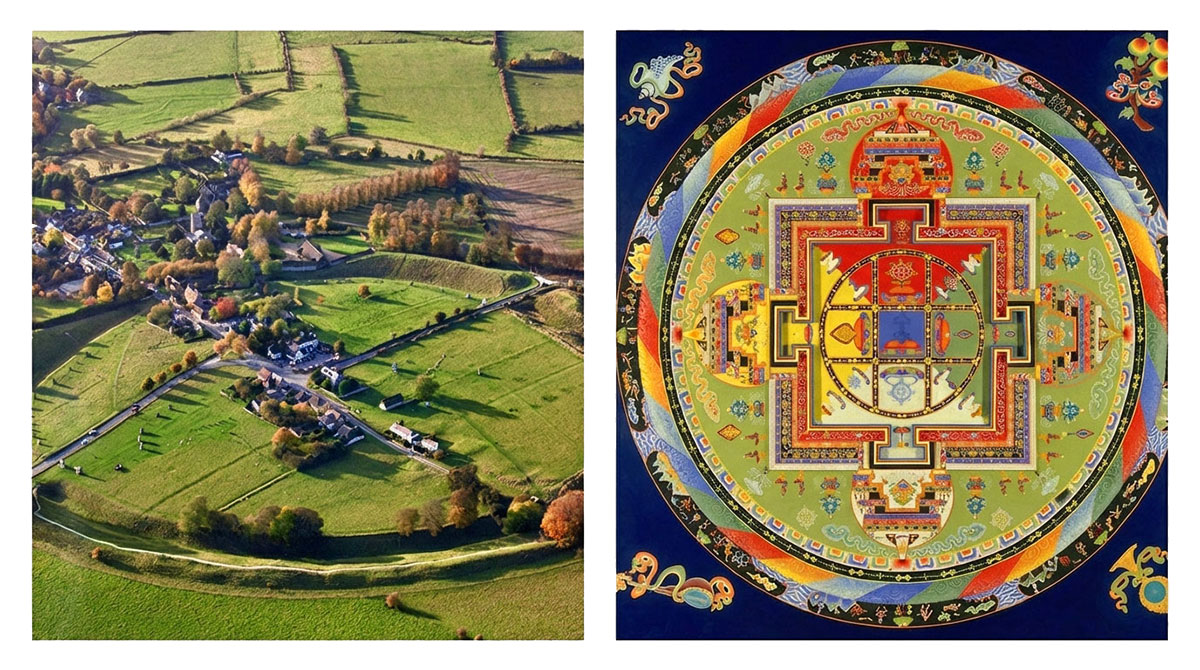
A mandala is not a casual decoration. It is a structured map of relationship: center, boundary, layers, direction, recurrence.
A yantra compresses geometry into a field of interlocking forms. Islamic tilework extends pattern across surfaces with astonishing discipline. The Mayan calendar system builds time itself into nested cycles, days inside larger cycles, larger cycles inside still larger ones.
The materials differ.
Stone. Sand. Tile. Time.
But the intuition is similar.
before it was explained.
The Missing Language
For centuries, these patterns remained scattered across disciplines.
Geographers studied coastlines. Biologists studied branching lungs and blood vessels. Physicists studied turbulence. Artists and builders used symmetry and recursion in sacred design.
Each field had part of the picture.
But no single language connected them.
That changed in the twentieth century.
Benoît Mandelbrot looked at forms classical mathematics had often treated as too rough, too irregular, too resistant to clean description. Coastlines. Clouds. Branching systems. Market fluctuations. Turbulence.
Instead of smoothing out the roughness, he followed it.
What emerged was a new way of seeing old forms.
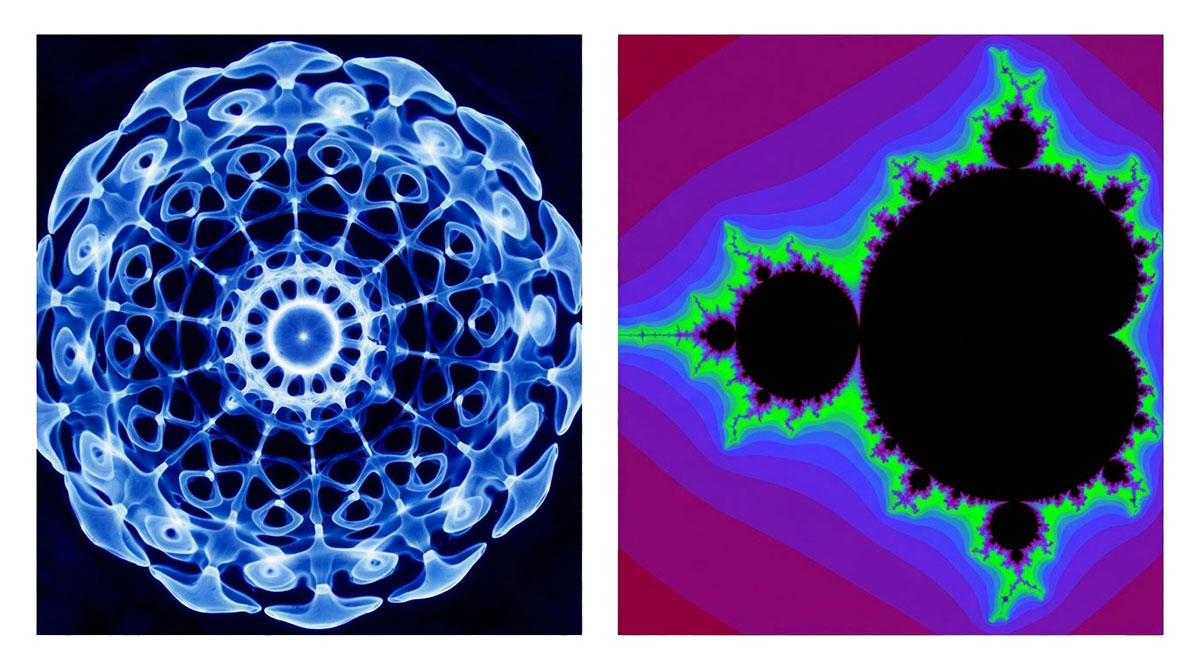
In 1975, Mandelbrot gave the pattern a name: fractal.
A fractal is a structure that repeats across scales. The part resembles the whole. Complexity arises through repeated process.
The mathematics did not create the pattern.
It made the pattern visible.
It was the recognition.
Sound Becomes Shape
Another clue came from vibration.
In cymatics experiments, fine particles or liquids are placed on a surface and exposed to sound. At certain frequencies, the material organizes itself into geometric forms.
Change the frequency, and the form dissolves.
Hold a new frequency, and a new structure appears.
The pattern is not being drawn from the outside. It emerges from the relationship between vibration, medium, and constraint.
This is why cymatic forms can resemble mandalas, tilework, or other symmetrical designs. Not because one copied the other, but because different systems can converge on similar structures when governed by similar principles.
without a central designer.
That idea is easy to underestimate.
It means order does not always have to be imposed. Sometimes it appears when a system is placed under the right conditions.
Water flows. Energy branches. Sound organizes matter. Cells divide. Trees grow. Time is counted in cycles.
Again and again, the same lesson appears.
Pattern is not the opposite of process.
Pattern is what process leaves behind.
What It Suggests
The convergence is not proof that all traditions were saying the same thing.
It is not proof that nature is designed in any simplistic sense.
But it does suggest that certain forms are not arbitrary.
Branching appears because distribution requires it. Recursion appears because simple rules can generate complex structures. Symmetry appears because systems under constraint often settle into stable relationships.
The ancient builder, the mathematician, the river, the lung, and the fern are not doing the same thing.
But they may be responding to the same deeper logic.
they often find similar forms.
This is where the idea becomes useful.
The world is not random at the level where it first appears irregular. The rough edge of the coast, the branch of the tree, the fork of lightning, the geometry of the lung — each carries structure that becomes clearer when viewed through the right lens.
Modern mathematics did not strip the mystery away.
It sharpened the mystery.
It showed that what looked chaotic might still be patterned.
Where This Leads
The coastline was never just a coastline.
It was an entry point.
Follow it closely enough and it opens into rivers, lungs, lightning, trees, mandalas, calendars, and mathematics.
The same pattern does not mean the same meaning everywhere.
But it does suggest that meaning often begins with recognition.
Something appears in one place.
Then again in another.
Then again, at a different scale, in a different form.
At first, it looks like coincidence.
Then it starts to look like structure.
structure repeats.
That may be the real lesson.
Not that every shape is a message.
Not that every pattern is mystical.
But that the world has been speaking in forms long before modern language learned how to describe them.
The geometry was already there.
The tools to read it arrived late.