The Shape That Keeps Returning
The same geometric forms appear in coastlines, lungs, lightning, river deltas, and ancient sacred designs — across cultures, materials, and billions of years. That turns out not to be a coincidence.
From 30,000 feet, the coastline outside your window should be simple.
A boundary. Land on one side. Water on the other. A line that any map can draw and any child can trace. Simple.
But here is the strange part: the closer you look, the longer the coastline gets. Bays open into smaller bays. Headlands break into smaller points. River mouths split into channels, and those channels divide again. Measure the coastline with a long ruler, and you get one number. Switch to a shorter ruler and the length grows. Use a finer instrument still, and it grows again. The coastline refuses to settle into one final answer — and it turns out, this is not a quirk of coastlines. It is a clue about how nature builds things. The same shape that refuses to resolve at the coast shows up inside your lungs, in a bolt of lightning, in the branches of every tree that has ever grown. Ancient cultures carved versions of it in stone. Modern mathematics needed almost two centuries to explain what it was doing there.
The pattern was not invented. It was recognized.
the longer the coast becomes.
The Same Shape, Everywhere
Start with the river delta, because the coastline question leads directly to it.
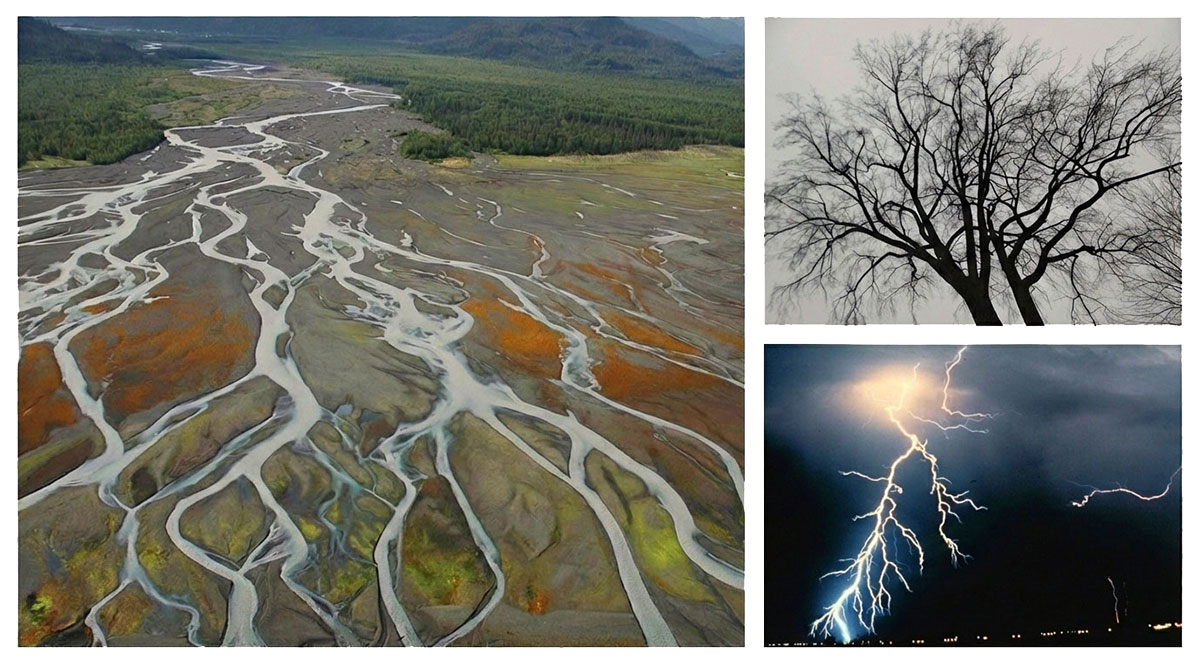
Water moves downhill, slows as it reaches flat ground, drops the sediment it was carrying, and divides. Each new channel faces the same pressure and divides again. From above, the delta looks exactly like a tree made of water — the same branching logic, down to the proportions of the branches. It is not a loose resemblance. It is essentially the same structure, built by the same underlying physics.
Then look at the tree itself. A trunk divides into branches. Branches divide into smaller branches, then into smaller ones still. This is not decorative — it is engineering. The branching pattern is nature's solution to a specific problem: how to move water, nutrients, and energy through a living system with maximum reach and minimum waste. The tree is a distribution network, and it turns out the most efficient distribution network available looks like a tree.
The same structure shows up in lightning. A single channel of energy splits as it moves through air, following the paths of least resistance. For one brief instant, the sky draws the same branching logic already written in roots, rivers, and blood vessels — then it's gone. Different material, different timescale, entirely different world. Still the same shape.
And then the inside of the human body. The branching of the airways in a lung follows the same pattern — trachea to bronchi, bronchi to smaller branches, on and on for more than twenty levels until the air reaches the tiny sacs where oxygen crosses into blood. If you could unfold the entire inner surface of a human lung and lay it flat, it would cover an area approaching a tennis court. That extraordinary surface area, packed into a space the size of two fists, is what branching accomplishes. It is not excess. It is efficiency of a very high order.
Same solution.
The question that keeps arriving, once the pattern is noticed, is the obvious one: why?
One Rule, All That Complexity
Pick up a fern frond. Hold it at arm's length and look at the whole thing. Now bring it closer and look at one leaflet. The leaflet has the same shape as the whole frond. Look even closer at a smaller division of that leaflet, and the shape repeats again. The pattern appears to go all the way down.
This raises a question that seems almost too obvious to ask: how does the fern know to do that?
The answer, it turns out, is that the fern does not know anything of the sort. It is not consulting a blueprint or carrying a picture of its own finished shape inside each cell. What it has is much simpler — and much more interesting.
Think of a set of Russian nesting dolls, the kind where each doll opens to reveal a smaller version of itself inside. Now imagine the dolls had the ability to keep making new smaller versions indefinitely, each one following the same basic shape as the last. No master plan required. No artist standing at the outside deciding how each layer should look. Just the same instruction, repeated: make a smaller version of yourself. That is, roughly speaking, what a fern does. In mathematics, this property — applying a rule repeatedly to its own output — has a name: recursion. And recursion turns out to be one of the most powerful pattern-generators in nature.
A single recursive instruction, repeated across scale, produces structures of breathtaking complexity from almost nothing. The fern is not complicated because it contains thousands of separate instructions. It is complicated because one simple instruction keeps unfolding. The branching of a lung works the same way. So does the forking of a river delta. So does the splitting of lightning.
It is function.
Once recursion is visible, it is difficult to stop seeing it. The blood vessels of the body branch and rebranch until they reach capillaries too fine to see with the naked eye. The neurons of the brain branch into dendritic trees, each one a forest of connections in miniature. The structure of a coastline, followed closely enough, reveals the same branching that a river's tributaries reveal from above. The scale changes. The shape persists.
Ancient Eyes
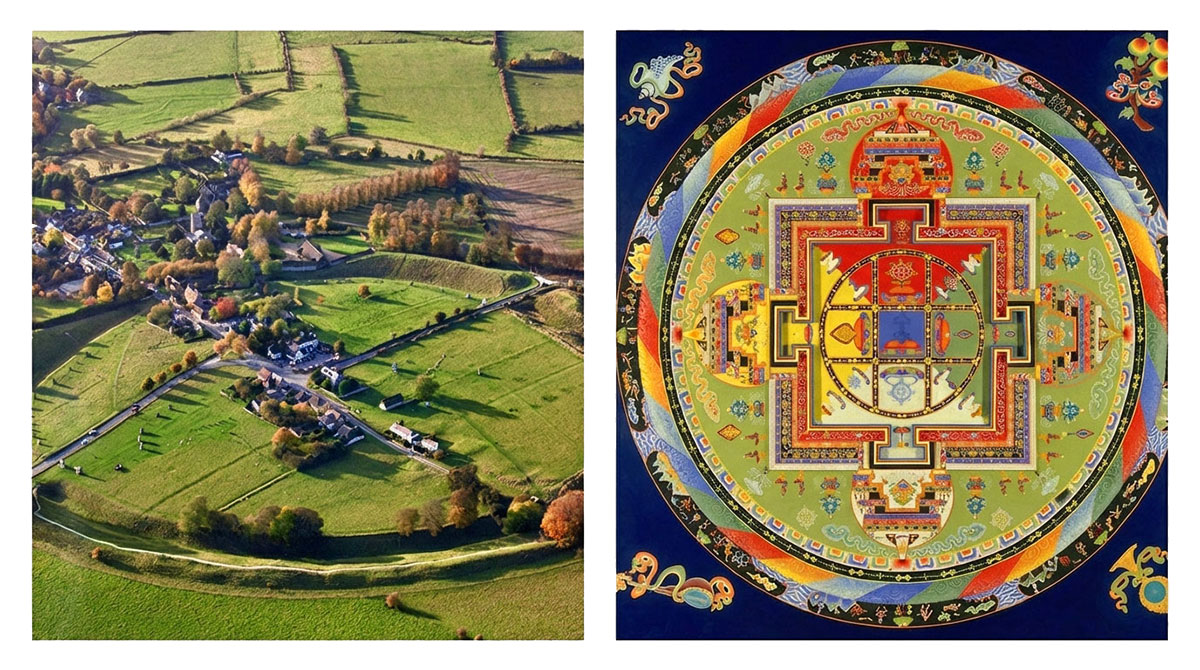
At Avebury in England, prehistoric builders placed enormous stones in circular arrangements without modern instruments, written geometry, or anything that survives as a formal mathematical system. Yet the proportions hold. The alignments are deliberate. The structure is clearly the product of minds thinking carefully about pattern, center, boundary, and repetition.
The same kind of careful thinking shows up, independently, across the world. Mandalas from Tibet and India encode geometry as a map of relationship: center, boundary, layers of increasing complexity radiating outward. Yantras compress interlocking geometric fields into forms designed to be held in mind as well as drawn on paper. Islamic tilework extends recursive pattern across surfaces with a discipline that, centuries later, turned out to be depicting mathematical structures that Western science did not formally describe until the twentieth century. The Mayan calendar builds time itself into nested cycles — days inside larger cycles, larger cycles inside still larger ones — a recursive structure applied to the measurement of time rather than space.
These traditions did not share one origin. They arose in different cultures, on different continents, using different materials and working within entirely different cosmologies.
Stone. Sand. Tile. Time.
But something familiar keeps returning. Symmetry. Repetition. Pattern within pattern. Nested structure. Center and circumference. This does not require a claim that ancient builders possessed modern mathematics, or that all traditions were secretly saying the same thing. It suggests something more grounded, and perhaps more interesting: the people building these things were looking very carefully at the world around them. And the world around them was full of the same shapes.
before it was explained.
The Man Who Followed the Roughness
For centuries, these patterns remained scattered across disciplines. Geographers studied coastlines. Biologists studied branching lungs and blood vessels. Physicists studied turbulence. Artists and builders used symmetry and recursion in sacred design. Each field had part of the picture. But no single language connected them, and the dominant tradition in mathematics had, if anything, actively set these forms aside.
Classical geometry — the kind built on circles, triangles, and smooth curves — had no real way to describe a coastline. It could approximate. It could smooth out the roughness and work with what remained. But the roughness itself, the detail that refused to go away no matter how closely you measured, was treated as a nuisance rather than as information.
It is worth pausing on that, because it is a genuinely strange idea. Take a digital photograph and zoom in far enough. The smooth image — a face, a landscape, a coastline — dissolves into a grid of individual colored squares. Up close it looks like chaos. But those pixels are not errors in the photograph. They are the photograph. Every one of those tiny colored squares is actual data about the original scene. Trying to smooth them away would not improve the image. It would destroy it. The roughness is the information.
In the 1960s and 1970s, a mathematician named Benoît Mandelbrot decided to do something similar with coastlines, price fluctuations, and the shapes of clouds. Where classical mathematics smoothed the irregularity away, he zoomed in on it.
Mandelbrot was, by temperament, a pattern collector. Born in Warsaw in 1924, he had grown up moving across Europe during some of the worst years of the twentieth century, educated informally, his schooling constantly interrupted. What he retained from that unsettled education was an unusual ability to think visually and to recognize shapes rather than to follow formal mathematical procedures in the conventional way. When he eventually landed at IBM's research lab in Yorktown Heights, New York, he was given something rare: the freedom to think about whatever seemed interesting.
What seemed interesting, it turned out, was everything the mainstream of mathematics had agreed to ignore.
Mandelbrot had developed an unusual habit: he kept noticing the same mathematical structures appearing in completely unrelated fields. Price fluctuations in financial markets had the same statistical shape as turbulence in rivers. The distribution of errors in telephone transmission lines had something in common with the clustering of galaxies. The shapes of clouds, the profiles of mountain ranges, the branching of river systems — all of them resisted description in classical geometry, and all of them showed the same underlying property when examined carefully. A generation of specialists had looked at these phenomena in isolation and found them puzzling. Mandelbrot looked at all of them together and suspected they were telling him something about how irregular forms actually work.
Instead of smoothing out the roughness, he followed it. He asked what happened when the irregularity itself was taken seriously as information rather than noise to be filtered away. What he found — working first by hand, then using the early computing power available at IBM — was that these rough, irregular forms all shared a defining property: their detail repeated across scales. The closer you measured, the more structure appeared, and the structure at the fine scale looked like the structure at the large scale. The part resembled the whole.
In 1975, Mandelbrot gave the pattern a name: fractal.
A fractal is a structure in which the same complexity appears at every scale of examination. The word comes from the Latin for broken or fractured — a nod to the roughness that classical geometry could not describe. The mathematics Mandelbrot developed did not create the pattern. It made the pattern visible, gave it a name, and connected the coastline to the lung to the river delta to the lightning bolt to the fern, all under a single description.
It was the recognition.
When Sound Makes Shapes
Another clue came from a completely different direction: vibration.
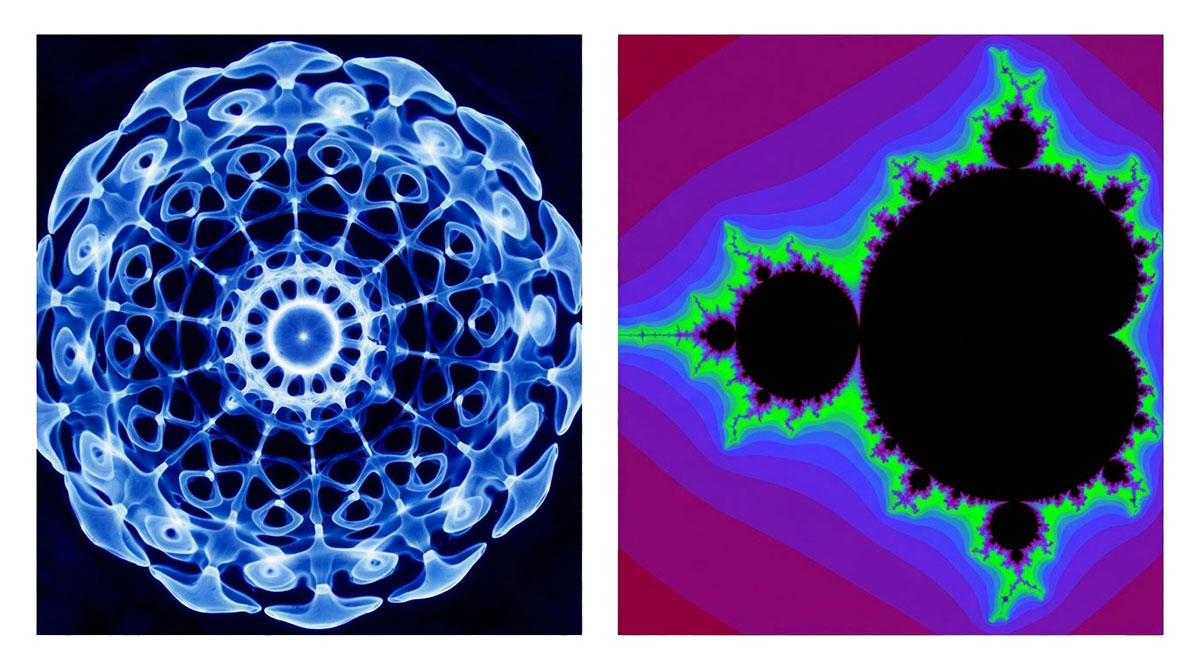
Take a shallow drum and scatter a thin layer of fine sand across the surface. Now bring a vibrating tuning fork near it. At the right frequency, something remarkable happens — the sand begins to move. Not randomly. It migrates away from the areas of maximum vibration and settles into the areas that are barely moving at all. And what it leaves behind is a geometric pattern: rings, stars, intricate symmetrical forms that look, depending on the frequency, like mandalas or Islamic tilework or the cross-sections of a plant stem.
Change the frequency, and the form dissolves back into randomness. Hold a new frequency, and a new geometric structure appears. The experiment is called cymatics, and it has been repeated in research settings with water, sand, and more exotic materials for more than two centuries.
The reason the sand arranges itself into patterns rather than simply shaking randomly is close to what happens with a jump rope. Two children hold the ends and shake it up and down. The rope forms a wave — but look carefully, and there are spots along it that barely move at all, staying almost still even while the ends are whipping wildly. Those still spots appear where the wave traveling from one end meets the wave traveling back from the other, and they cancel each other out. The rope shows you the pattern before you know what to call it. In physics, those still points are called nodes. The wildly vibrating areas between them are antinodes. On the cymatics drum, the sand bounces frantically in the antinodes — so it gets pushed, grain by grain, until it falls into the nodes, the still pockets. What looks like a mandala is actually a map of where the wave goes quiet.
The pattern is not being drawn from the outside. It emerges from the relationship between the vibration, the medium it is traveling through, and the physical constraints of the surface it is crossing.
This is why cymatic forms can so closely resemble traditional sacred designs without any historical connection between them. It is not that one copied the other. It is that different systems — sound waves moving through sand, human hands pressing clay or tile or sand — can converge on similar structures when they are governed by similar underlying principles. The geometry is not cultural first. It is physical first.
without a central designer.
That idea is easy to underestimate. It means order does not always have to be imposed from the outside. Sometimes it appears when a system is placed under the right conditions — when vibration, energy, or process finds its natural resting state. Water flows downhill and builds a delta. Energy branches through air and builds a lightning bolt. Sound vibrates through sand and builds a mandala. Cells divide according to a simple rule and build a lung. The same logic running through different materials, leaving the same shapes behind.
What Nature Is Doing
The convergence across all these systems is not proof that ancient builders understood fractal mathematics, or that nature is designed in any simple teleological sense. But it does suggest that certain forms are not arbitrary — that they appear because the physical world, under a range of conditions, tends toward them.
Branching appears because distribution requires it: any system that needs to reach many points from one starting place, efficiently and without redundancy, is going to end up with a branching structure. Recursion appears because applying a simple rule repeatedly is one of the most energy-efficient ways to generate complexity. Symmetry appears because systems under certain kinds of constraint — vibration, pressure, balanced forces — often settle into stable, balanced relationships. The forms are not imposed. They are found.
This is where the ancient observation and the modern mathematics are telling the same story from different ends. The person carving a mandala into stone was following an intuition that certain arrangements feel right, feel balanced, feel true to something — and it turns out that intuition was tracking the actual behavior of physical systems under constraint. The mathematician following the roughness of a coastline was working toward a formal description of the same phenomenon. They arrived at similar structures because the structures were there to be found.
It is worth staying with that for a moment. The discovery was not that nature is geometric in some loose, metaphorical sense. The discovery was that specific geometric properties — self-similarity across scales, recursive branching, symmetry under constraint — appear in living systems, in weather, in rock and water, in sound, and in the mathematical structures that describe them, because those properties represent solutions to real physical problems. Branching is efficient. Recursion is generative. Self-similarity means a system can be complex without being complicated in a way that requires extraordinary information to sustain. Nature, as it happens, is conservative. It reuses what works.
they often find similar forms.
Modern mathematics did not strip the mystery away. It sharpened it. What looked like chaos at the edge of the coastline, it turns out, carries structure. What looked like decoration in a fern frond is engineering. What looked like coincidence — the same shape in a lung and a river and a lightning bolt — is convergence. The same constraints, the same logic, the same answer.
Where the Coastline Takes You
Return to the coastline. Same view from 30,000 feet. Same apparent simplicity. Land. Water. A line.
But the line is different now. Follow it closely and it opens into rivers, lungs, lightning, fern fronds, mandalas, and the mathematics of a researcher in an IBM lab in the 1970s who decided the roughness was worth following. The coastline was not a boundary. It was an entry point — the first clue in an argument that nature has been making across billions of years and dozens of domains, patient enough to write the same message in stone and sand and living tissue and the mathematics of turbulence.
That gap — between pattern recognized and pattern explained — is where most of human knowledge has always lived. The ancient builders at Avebury did not need Mandelbrot's equations to recognize that certain proportions feel true to something real. The fern did not need to understand recursion to use it. The gap between recognition and explanation is not a failure. It may be the most honest description of where the work actually happens.
And here is what the pattern, once noticed, keeps doing: it expands the category of things worth looking at. If a branching structure in a river delta and a branching structure in a lung are obeying the same logic, the question of why that logic keeps appearing is a question about nature at a fairly deep level. If sound vibrating through sand and human hands pressing tile independently arrive at the same geometric forms, something worth investigating is driving that convergence. The coastline that refuses to resolve into one final measurement is not a flaw in the instrument. It is information.
structure repeats.
The geometry was already there.
The tools to read it arrived late.