The Same River Twice
The same mathematics governs blood flowing through vessels, traffic moving through cities, rivers carving through rock, data moving through networks, and matter drifting along cosmic filaments. The form persists. The materials change.
The light turns yellow.
The car at the front of the intersection pushes through. The one behind it hesitates — just for a moment, just long enough to decide — and brakes. The car behind that one brakes a little harder. The one behind that one harder still. A wave of red brake lights moves backward through traffic, rippling away from the intersection like a stone dropped in still water.
Here is the strange part: every car in that line is moving forward. The wave is moving backward. The cars and the wave are traveling in opposite directions at the same time, through the same space, without contradiction.
This is not a quirk of traffic. It is not a failure of the system. It is the system doing something that turns out to be one of the most fundamental behaviors in nature — something that shows up in the blood moving through your body right now, in the rivers carving through rock over millions of years, in the invisible infrastructure carrying every message you have ever sent, and in the largest structures in the observable universe.
Flow, it turns out, has rules. The same rules. Everywhere.
And the most surprising of those rules is this: the systems that move best are not the ones with the strictest controls. They are the ones with just enough local flexibility to absorb strain, redistribute pressure, and find their own way through. The backward-moving wave in the intersection is not a malfunction. It is a flow system doing exactly what flow systems do.
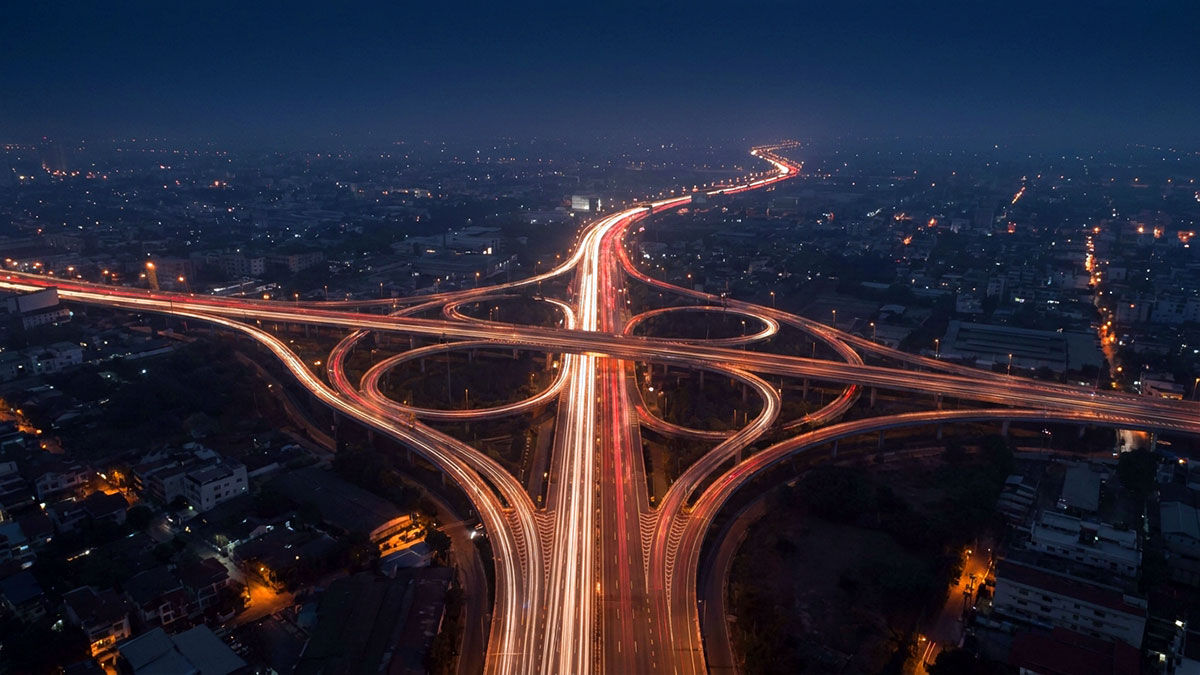
The River Inside You
The heart beats roughly once per second. Blood moves. Simple enough picture.
Except blood does not move the way most people imagine it — smooth and steady, like water from a tap left running. It surges and slows with every heartbeat, squeezes through vessels that narrow and branch, navigates forks and junctions at every scale from the aorta down to capillaries thinner than a human hair. And occasionally — when a vessel narrows from plaque, or when demand suddenly spikes in a working muscle — the system hits a bottleneck it has to route around in real time.
The closest familiar version of this is a highway interchange at rush hour. Cars stack at the merge point. Pressure builds behind. The slowest lane sets the pace for everything. Drivers who can, shift to alternate routes. The system redistributes. Inside a blood vessel, the physics are nearly identical — except the cars are red blood cells, the merge point is a narrowed artery, and the traffic engineer is the cardiovascular system itself, adjusting pressure gradients and rerouting flow without instructions from any central command.
When flow inside a vessel is smooth and layered — each ribbon of blood gliding alongside the next without mixing — it is called laminar flow. It is efficient, quiet, low-resistance. Push the velocity too high, or squeeze the channel too narrow, and the layers break apart into chaotic swirling. That is turbulence, and it costs energy. The cardiovascular system spends considerable biological resources keeping flow laminar in the vessels where it matters most, and tolerating turbulence only where the geometry makes it unavoidable.
What happens when a vessel is blocked? The body does not wait for a rerouting instruction. Pressure redistributes through the network. Collateral vessels — parallel pathways that exist precisely for this contingency — dilate and carry more load. The system finds another way through, the way water finds another way downhill when one channel is dammed. It does not need a planner. It needs the right architecture and the right local responsiveness.
In the 1950s, mathematicians working on traffic theory made an observation that unsettled the field. James Lighthill, M. J. Whitham, and Paul Richards, working independently, showed that a column of traffic could be modeled as a compressible fluid. The mathematics already developed for blood flow and river hydraulics — the equations describing density waves moving through a medium — described traffic behavior with uncomfortable precision. A jam front is a shockwave. It propagates backward through the fluid while the fluid itself moves forward. The math did not care whether the medium was plasma or automobiles.
The cardiovascular system handles pressure, congestion, and rerouting without a central controller — billions of local decisions producing a coherent global flow. Cities, it turns out, tried to do the same thing with roads. And for a long time, they got it exactly backward.
The Road That Made Things Worse
Seoul, South Korea. 2003.
City engineers announce plans to demolish the Cheonggyecheon Expressway — an elevated highway running through the center of the city, carrying 168,000 vehicles per day. Traffic planners model the outcome. The models predict gridlock. Residents brace for chaos. Business owners near the highway protest.
The expressway comes down anyway. A stream that had been buried under concrete for decades is restored in its place. Parks appear along the banks.
Traffic improves.
Not marginally. Measurably, persistently better — less congestion, not more, despite removing a major artery from the network. The same result appeared in San Francisco when the Embarcadero Freeway came down after the 1989 earthquake. In Milwaukee, when the Park East Freeway was demolished. In Portland. In Madrid. Engineers who had spent careers adding capacity to urban road networks were confronted with a counterintuitive result: removing roads could make traffic flow better.
There is a name for this. It is called Braess's Paradox, after the German mathematician Dietrich Braess who described it formally in 1968. The paradox works like this.
Picture a crowded restaurant where everyone is trying to reach the buffet. There are two routes through the room — one along the left wall, one along the right. The crowd distributes itself, some going each way, and the buffet moves steadily. Now someone opens a shortcut through the kitchen. At first, it helps — a few people take the new path and things speed up. But then everyone notices the shortcut. They all take it. The shortcut, which was never designed for full restaurant traffic, becomes the new bottleneck. It is narrower than either original path, and now it is handling everything. The original routes, now nearly empty, sit idle.
This is not a failure of planning. It is a consequence of individual rationality producing collective inefficiency. Every diner choosing the shortcut is making the locally correct decision. Together, they make the system worse. In traffic networks, the same dynamic plays out at city scale. A new road that looks like relief draws traffic away from a functioning distributed network and concentrates it in a new bottleneck. The overall system slows.
Remove the shortcut, and drivers spread back across the full network. The distributed architecture, with all its apparent redundancy and inefficiency, turns out to be precisely what kept things moving.
The body appears to have understood this long before Braess named it. Research into vascular network geometry has found Braess-like effects in biological systems — configurations where adding a vessel reduces overall flow efficiency. Evolution, working across millions of years with pressure and flow and selection, arrived at network architectures that avoid the paradox. Not because any designer recognized it, but because networks that suffered it lost efficiency and were replaced by networks that did not.
Braess found his paradox in an equation. Rivers found the same answer in stone — and arrived at a solution that engineers spent two centuries trying to undo.
What the River Knows
A river does not flow straight.
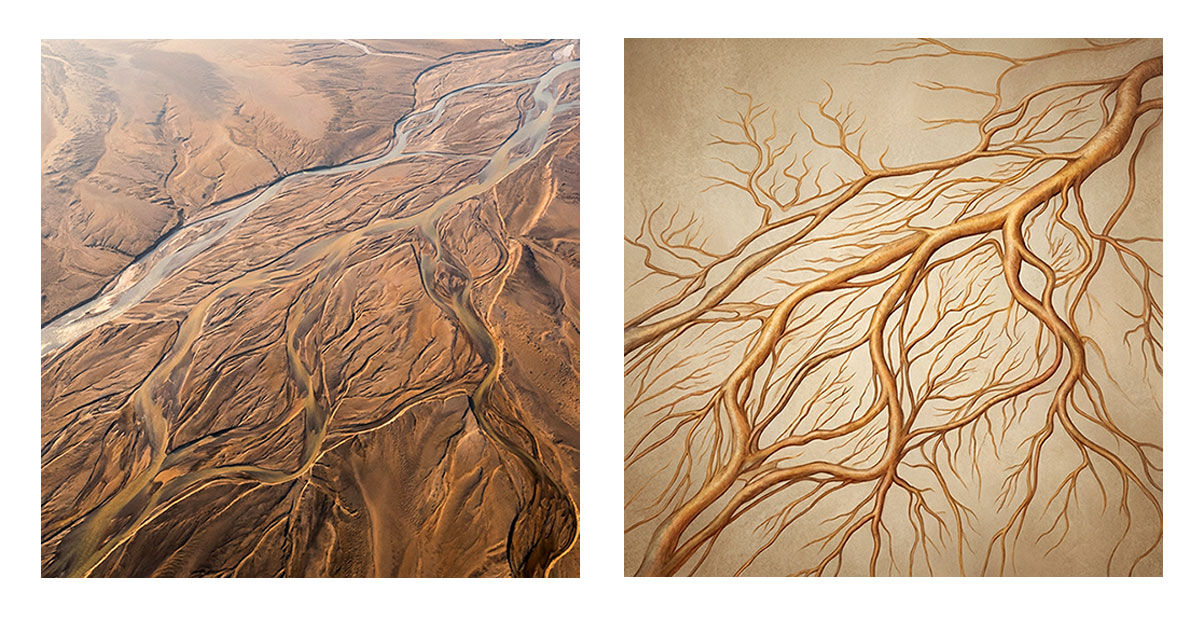
Given flat enough terrain and enough time, any river will begin to curve. The curves deepen. The bends grow more pronounced, looping back on themselves in great sweeping arcs until eventually a bend curves so far it meets itself, pinches off, and leaves behind a crescent-shaped lake — an oxbow — marooned beside the new, slightly shorter channel. Then the process begins again.
Engineers have been straightening rivers for two centuries. Flood control. Navigation. Land drainage. The results are consistent and instructive: the rivers keep trying to bend. They simply do it further downstream, faster, with more energy, and harder on the banks.
Imagine pressing your thumb over the end of a garden hose. The pressure builds immediately behind the restriction. The moment you release it, the water comes out faster and more forcefully than before. Straighten a river and something similar happens at a much larger scale. The water, no longer distributing its energy across the long, leisurely path of a meander, concentrates that energy into a shorter, faster channel. It hits the banks harder. It erodes more aggressively. Downstream flooding often worsens. The river was not being inefficient before. It was distributing energy across the landscape in a way that kept the system stable. Remove the distribution, and the energy has to go somewhere.
The mechanism inside a river bend is called helicoidal flow — a slow spiral that develops as water moves around a curve. Fast-moving water on the outside of the bend hits the bank and erodes it. Slower water on the inside drops sediment and builds up. The outside bank retreats; the inside bank advances. The bend deepens. A deeper bend produces stronger helicoidal flow. Stronger flow deepens the bend further. The whole process is self-amplifying, emerging from a tiny initial irregularity and growing over time through nothing more than water obeying physics.
The mathematician Luna Leopold and his colleague M. Gordon Wolman studied rivers on multiple continents in the 1960s and found something that should have been surprising but turned out to be exact: the wavelength of a river's meander — the distance from one curve to the next — is consistently seven to twelve times the width of the channel, regardless of the river's size. The Mississippi follows this ratio. So does a small stream in a meadow. So does a meltwater channel on a glacier. The geometry is not regional. It is not geological. It belongs to the physics of flow itself.
In the 1990s, engineers re-meandered a stretch of the Kissimmee River in Florida that had been channelized for flood control in the 1960s. The straight concrete channel had degraded the surrounding ecosystem substantially. When the curves were restored, the wetlands recovered, wildlife returned, and — critically — downstream flood management improved. The meander was not the problem. The meander was the solution.
In 1922, a British mathematician named Lewis Fry Richardson was thinking about turbulence — about how energy moves through a fluid when the flow is not smooth. He wrote it in a verse that has outlasted most of the scientific papers of his era:
Big whirls have little whirls that feed on their velocity, and little whirls have lesser whirls and so on to viscosity.
What Richardson was describing is called the turbulent cascade. Energy enters a fluid at a large scale — the whole river moving downstream. It breaks into large eddies. Those break into smaller eddies. Those break into smaller ones still, each inheriting the same rotating logic as the one above it, all the way down to the molecular scale where friction finally absorbs the last of it as heat. The meander is the cascade made visible in landscape. The spiral inside the bend is the same logic at a smaller scale. The turbulence at the surface of the water is the same logic smaller still. The river is Richardson's verse written in mud and stone.
Richardson spent years trying to do something that seemed almost absurd: predict the weather mathematically. He imagined a vast circular hall — 64,000 human calculators seated in tiers, each one responsible for solving the atmospheric equations for one small patch of sky, all working in parallel, coordinated by a conductor at the center. His forecast factory never existed. The computation was impossibly slow by hand. But decades later, when electronic computers arrived, meteorologists looked at his proposal and realized he had described, almost exactly, how numerical weather prediction would actually work. The tools arrived long after the idea. The idea was correct.
Richardson had also spent time measuring the length of coastlines — noticing that the length kept changing depending on the scale of measurement, that roughness did not smooth away no matter how closely you looked. That observation eventually reached a mathematician named Mandelbrot, who followed the roughness all the way to fractal geometry. The same coastline. A different instrument. A different century. The same pattern refusing to resolve.
Richardson's cascade describes energy finding its way through a physical fluid, scale by scale. In 1986, a researcher named Van Jacobson watched the same logic collapse an entire network — and spent a weekend figuring out how to give it back its curves.
The Internet Learned to Breathe
October 1986. The early internet — still small, still mostly universities and research labs — begins slowing to a near stop.
Not because a cable fails. Not because a server crashes. Because the computers connected to the network are polite in precisely the wrong way: when a data packet fails to arrive at its destination, they send it again. Immediately. And when that one doesn't arrive, they send it again. Into a network that is already overwhelmed. The retransmissions add to the load. The load causes more packets to fail. More failures trigger more retransmissions. The harder the network works, the less useful work it accomplishes.
Imagine a stadium exit at the end of a game. Everyone heads for the doors at once. The doorway jams. The people in front cannot move because of the crush from behind. The people in back, unable to see what's happening at the front, keep pushing. The harder everyone pushes, the slower the exit becomes. The problem is not the size of the door. It is that everyone is applying maximum force simultaneously, and the collective pressure makes movement nearly impossible.
That is what the early internet was doing to itself. Engineers had a name for the result: congestion collapse.
A researcher at Lawrence Berkeley National Laboratory named Van Jacobson was watching the network between his lab and UC Berkeley drop to a small fraction of its normal throughput during one of these episodes. He understood what was happening. The network was not broken. It was defeating itself — a system in which more effort produced less useful output, which is the precise signature of a flow system that has lost the ability to regulate its own pressure.
His solution was counterintuitive enough that it took time to be accepted. Teach the network to slow down. When a sender detects signs of congestion — packets failing to arrive, acknowledgments going silent — reduce the sending rate. Don't push harder. Back off. Give the jam room to clear. He introduced the concept of a congestion window: a limit on how much data could be in transit at once before waiting for confirmation that it arrived. When the network looked clear, open the window wider. When strain appeared, close it down.
Jacobson's 1988 paper became one of the foundational documents of the internet. The protocols he described are still running in the device used to read this article. The internet that exists today — carrying volumes of traffic Richardson's forecast factory could not have calculated — survives because it learned to sense its own strain and respond with restraint rather than force.
Network engineers did not derive TCP from the Navier-Stokes equations. But the language they reached for, independently, was fluid language. Flow. Pressure. Congestion. Backoff. Packets moving through bottlenecks, subject to the same basic logic as blood cells navigating a narrowing vessel or water building behind a thumb on a hose. The mathematics underneath is not identical. But the behavior is — and the solution is the same. Not more force. More flexibility. Enough local responsiveness to absorb strain and redistribute it before it becomes collapse.
Jacobson's internet learned to read its own condition and respond. The universe has been doing this for thirteen billion years — at a scale that makes the internet look like a single intersection on a quiet street.
The Largest Rivers in the Universe
Step back far enough from the universe, and the view becomes familiar.
Not scattered points of light. Not random distribution. Filaments — long threads of matter stretching across hundreds of millions of light-years, connecting dense bright knots where galaxy clusters have accumulated, surrounding vast dark bubbles where almost nothing exists. The universe is not a uniform fog of galaxies. It is a web. And the web flows.
Picture this: the way water moves downhill toward the lowest point in a landscape, matter in the universe moves downhill along the gravitational landscape — toward the densest regions, along paths of least resistance. The cosmic filaments are those paths. Gas, dust, and galaxies drift along them over billions of years, the way silt moves along a river toward the delta, accumulating at the destination. The destination is a galaxy cluster — a knot in the web where the inflow from multiple filaments has been converging since shortly after the universe began.
In the 1980s, two astronomers at the Harvard-Smithsonian Center for Astrophysics — Margaret Geller and John Huchra — began doing something nobody had attempted at scale: mapping nearby galaxies in three dimensions. Not just where they appeared in the sky, but how far away they actually were. The project was painstaking. The maps built up slowly, galaxy by galaxy, as redshift measurements came in.
What emerged from the data was not what anyone expected. The galaxies were not randomly distributed. They were arranged in sheets and filaments, surrounding enormous empty voids — regions of space spanning hundreds of millions of light-years containing almost nothing. The first map revealing the Great Wall, a sheet of galaxies stretching 500 million light-years, was published in 1989. It landed in the astronomical community the way a satellite photograph of an unknown continent would land on a cartographer's desk. The universe had structure at a scale nobody had imagined. And the structure looked like a web.
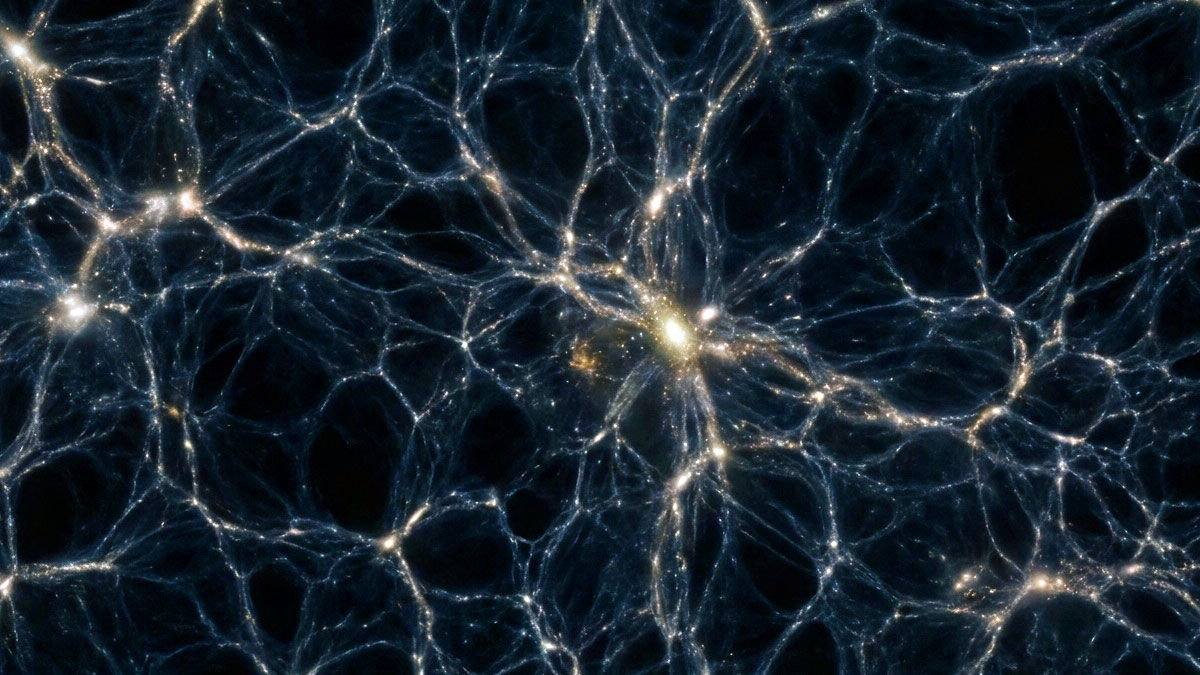
The cosmic gas flowing along these filaments obeys the same family of equations used to model blood in vessels and air in the atmosphere. Not identical — cosmic gas is almost unimaginably dilute, gravity-dominated rather than pressure-driven, moving on timescales that make geology look hurried. But the mathematical grammar is the same. Flow. Density. Pressure gradients. Convergence at nodes. The Navier-Stokes equations, and the family of fluid descriptions that grew from them, appear at every scale physicists have looked — from the micron-scale of a capillary to the megaparsec-scale of a cosmic filament stretching across a third of the observable universe.
The same rules. Different ingredients. Incomprehensibly different scales. Still the same rules.
The Backward-Moving Wave
Return to the intersection.
Same moment. The light turning yellow. The car at the front pushing through. The hesitation. The brake lights cascading backward through traffic while every car continues moving forward.
What was happening in that intersection has a name — a phantom traffic jam, a shockwave in a compressible fluid — and it obeys the same mathematics as the blood moving through the vessels in the hands on the steering wheel, the same logic that caused Seoul's engineers to discover that tearing out a highway could unsnarl a city, the same cascade Lewis Fry Richardson wrote a verse about while imagining 64,000 people computing the weather by hand, the same restraint Van Jacobson taught a collapsing internet on a weekend in 1986, the same gravitational pull drawing matter along filaments toward the bright dense knots of galaxy clusters scattered across the observable universe.
None of these systems share materials. They do not share scales. They do not share timescales. A red blood cell and a galaxy cluster have nothing in common except the mathematics of what happens when things flow through networks under constraint.
And that mathematics keeps returning the same answer: the systems that move best are not the ones that enforce the most rigid rules. They are the ones with enough local flexibility to sense strain and respond to it — to back off when the pressure builds, to reroute when one path closes, to distribute energy across the network rather than forcing it through a single channel. Blood does this. Rivers do this. The internet does this. The universe does this.
The car that ran the yellow light was not breaking the system. Under the right conditions, it was what kept the system from seizing — one local decision absorbing a moment of strain and letting the flow continue. The backward-moving wave that followed was the network processing that decision, passing it through the system, and moving on.
The mathematics does not.