The Cost of Seeing
The hidden states of the body, the bridge, the planet, and the sky stayed invisible for centuries — not because they were unknowable, but because looking cost too much. What happens when the price of seeing finally collapses?
The machine hums. You hold still. Somewhere in the room, an image assembles itself on a screen.
And there it is. Something that has been there for weeks, perhaps months — a change in tissue, a narrowing, a shadow with no pain attached to it. It does not hurt. It has not announced itself. It was simply there, doing what it does, in the dark. The body sent no message. The body had no reason to.
The machine found it anyway.
What the scan found was not a new arrival. The condition had already crossed whatever threshold it crossed, already changed what it changed, already settled into the interior of a living body without any signal reaching the surface. The only thing that changed was the price of looking.
That shift — the cost of seeing something falling far enough to make looking routine — turns out to describe one of the most persistent and undernoticed patterns in the history of human knowledge. Systems appear mysterious or unpredictable not because they are unknowable, but because the cost of seeing inside them is too high. When the price falls, the hidden state appears. What was always there becomes visible.
The room was lit briefly and rarely. Then the lights stayed on.
What Lived Inside the Wall
There is a slow leak behind the wall. The pipe is wet, corroding, failing — but nothing about the surface says so. Months pass. Then a stain appears on the ceiling. Only now is the interior condition visible. Only now can anything be done. And much of the damage has already settled in.
Before medical imaging, the interior of the human body operated by roughly the same logic. Physicians could tap on the chest, press on the abdomen, observe the surface for years, draw careful inferences. But the interior — its fractures, its tumors, its accumulating disease — was sealed off from the eye. Most internal pathology was confirmed at autopsy, when the body was finally opened after death had already settled the question.
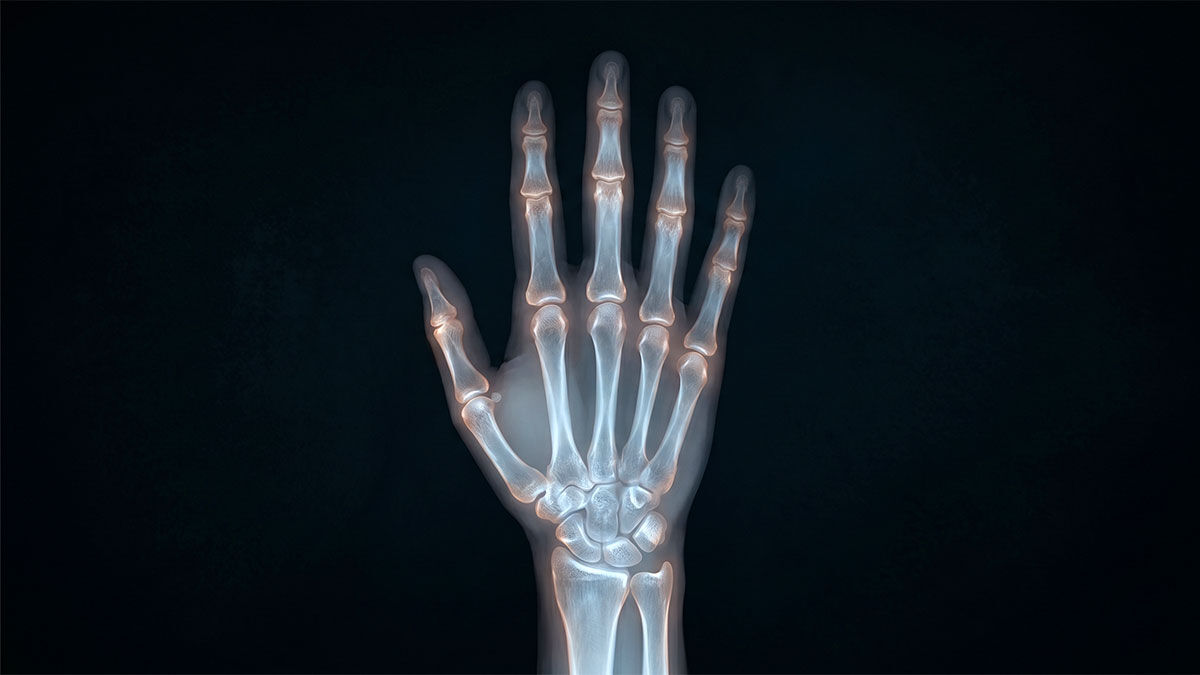
Then Wilhelm Röntgen, working in November 1895 at the Physical Institute of the University of Würzburg, noticed something strange while experimenting with a cathode-ray tube: a fluorescent screen across the darkened room lit up, even with a sheet of cardboard between them. Something was passing through solid material. He called it an X-ray and, within weeks, produced a photograph of his wife's hand — bones and soft tissue, visible without any incision. A living body, seen from inside.
Within months, physicians across Europe and North America were using X-ray images to confirm fractures, locate foreign bodies, and identify lung disease in living patients — work that had previously required surgery or a post-mortem examination. Historians of radiology would later describe early CT scanning in similar terms: a "living autopsy" — the body seen in life as it had once been visible only in death.
What the phrase names is not the invention of disease. It names the appearance of disease that was always there, finally dragged into visibility.
The crossover detail that links medicine to everything that follows comes from Glasgow, in 1958. Ian Donald, then Regius Professor of Midwifery at the University of Glasgow, was adapting a commercial device designed to find hidden cracks in industrial metal — a flaw-detector manufactured by the engineering firm Kelvin & Hughes. Working with engineer Tom Brown, Donald published the results in The Lancet: ultrasound waves built for identifying defects in steel had been turned toward the human womb. The instrument that listened for fatigue in metal structures was now showing the outline of an unborn face. A tool built to find hidden flaws in bridges and beams had become the tool for seeing the unborn.
The machine now finds things the body would never have mentioned. Not everything it finds needed to be found.
The Things That Snap Without Warning
Take a metal paperclip. Bend it back and forth. For a while, nothing happens. The clip gives a little, springs back, gives again. Then, with no warning, it snaps. No crack announced itself. No visible damage accumulated on the outside. The failure arrived suddenly, as if from nowhere — but it was not from nowhere. Deep in the metal, at the microscopic scale, something had been happening with every single bend.
August Wöhler, working for the German railway administration from the 1850s through the 1870s, spent years bending metal specimens until they broke. The crisis that drove him was real: railway axles were failing catastrophically at stresses well below what should have broken them — not from overloading, but from being loaded and unloaded millions of times. Wöhler's experiments established that cyclic stress accumulates invisible damage inside metal until the material simply runs out of capacity. The axle's interior was doing something no external inspection could detect.
For a century, civil infrastructure operated by the same logic. Inspect the surface. Tolerate what cannot be seen. Wait for the structure to announce its interior condition by collapsing. The aircraft industry learned this lesson most expensively. In January and April of 1954, two de Havilland Comet jetliners broke apart in flight. The Comet was the world's first commercial jet airliner — pressurized, fast, modern. When investigators at the Royal Aircraft Establishment at Farnborough submerged a complete fuselage in a water tank and pressurized it thousands of times, cracks appeared exactly where the airframes had failed: at the corners of the square windows. The metal had been counting every pressurization cycle, invisibly, since the aircraft was built. The structure had been failing for months before it failed.
If you have ever looked out the window of a commercial aircraft, you have seen the solution. The windows are oval. The radius distributes stress rather than concentrating it. Airplane windows are round because the Comet's square ones cracked at the corners — a fact engineered in metal and quietly present in every flight since.
The cost-collapse in structural monitoring followed: strain gauges, fiber-optic sensors, acoustic emission microphones that listen for the ultrasonic click of a crack growing inside a cable. A bridge, it turns out, makes sounds as it deteriorates — its interior announcing itself, if the right instrument is listening.
Monitoring does not only deliver warnings. In one documented study of the I-80 Sugar Creek Bridge, monitoring sensors showed that the structure was in substantially better condition than conservative engineering estimates had assumed. Replacement was postponed by up to thirty-seven years. Cheaper seeing sometimes earns the confidence to do less. The hidden state, when it finally becomes visible, is not always what was feared.
A Movie Instead of a Reconstruction
Consider trying to understand a river by taking still photographs from one bank, once a day. Something is captured. But the storm upstream is invisible. The eddies, the moment the whole watershed shifted — gone between frames. To understand a moving system, the still photograph is a limited instrument. What is needed is the film.
For most of human history, that is how the atmosphere was observed. Surface stations, ship reports, occasional weather balloons — all point measurements, sparse over the oceans and poles, capturing a global system at widely scattered moments. The atmosphere's actual state across the vast regions where no one was watching was inferred, extrapolated, reconstructed from incomplete data.
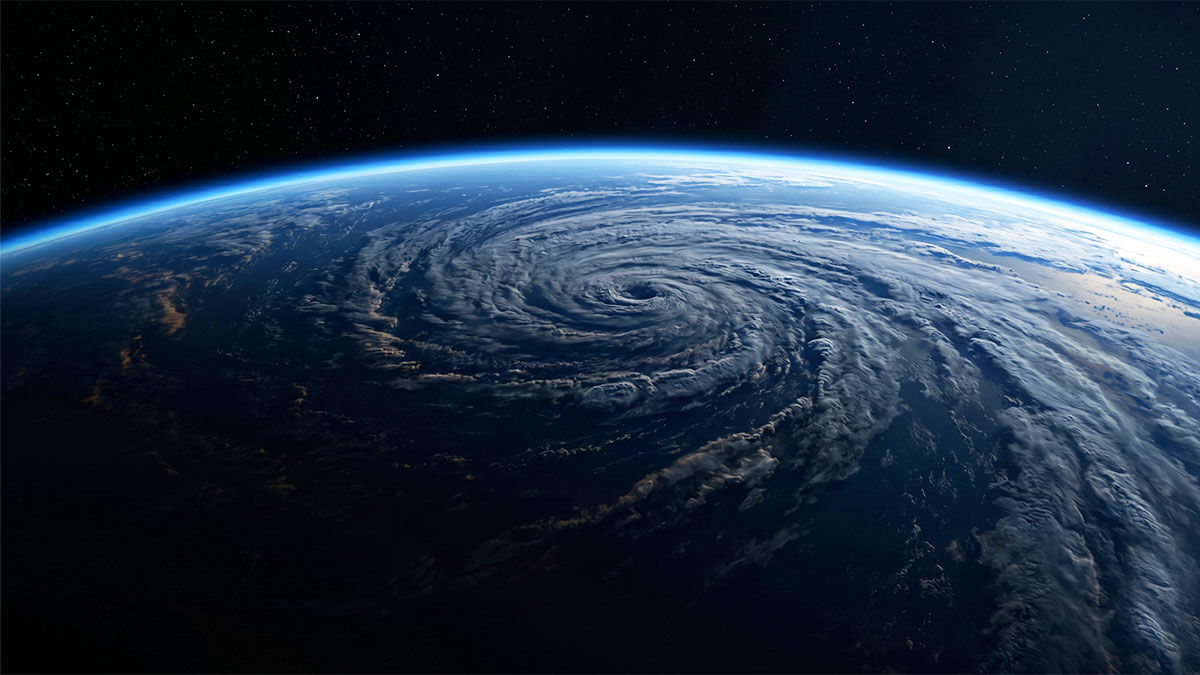
On April 1, 1960, TIROS-1, the first operational weather satellite, returned cloud-cover images of storm systems spiraling over remote oceans. Meteorologists could see, for the first time, weather events in places where no ship had been. The images were still photographs of a moving system.
Six years later, Verner Suomi, then at the University of Wisconsin, changed that. His spin-scan cloud camera, aboard the ATS-1 satellite launched in December 1966, produced the first full-disk images of Earth from geostationary orbit: the entire hemisphere, assembled line by line as the satellite spun, refreshed every twenty minutes. The camera let scientists watch the clouds move rather than the satellite. Weather became a movie instead of a reconstruction.
The planet had one more thing to show.
In 1985, Joseph Farman, Brian Gardiner, and Jonathan Shanklin of the British Antarctic Survey published a paper in Nature reporting a dramatic springtime loss of ozone over Halley Bay, Antarctica — October values had fallen by roughly forty percent since the late 1970s. They had found the ozone hole using ground-based instruments, measuring patiently for decades.
Meanwhile, satellites overhead had been recording identical low ozone values for years. The quality-control algorithms used to process the satellite data flagged the readings as probable error and set them aside — the numbers fell outside the expected range of ozone values, and the software treated them as likely instrument malfunction. The signal had been in the satellite data back to at least 1976. It went unseen because the system enforcing prior expectations could not permit the data to say what it was actually saying.
The ozone hole was not hidden because the instruments couldn't see it. It was hidden because no one believed what the instruments had been seeing all along.
The Price of a Photon
A pinhole in a piece of cardboard, held up to the sky, admits one small shaft of light at a time. An open bucket left out in the rain collects every drop that falls. The difference between these is approximately the difference between a photographic plate and a modern digital detector in the history of astronomical observation.
Photographic plates captured roughly three percent of incoming photons — for every hundred that entered the telescope, ninety-seven were lost. Modern charge-coupled devices capture well over half, and exceed ninety percent at their peak. The best modern detectors catch light roughly two hundred times more efficiently than the best photographic plates ever did.
In the other three domains, "the cost of seeing" is a figure of speech. Here, it is a measured ratio. The universe had not changed. The sky was not any brighter. What changed was how many of its signals were being caught.
The Harvard Observatory's collection of roughly half a million glass photographic plates, exposed between 1880 and 1985, contains five hundred to a thousand images of every patch of sky it covered — a century of the dynamic universe, recorded in glass. The sky had been faithfully recording itself for a hundred years.
The records were always there, waiting to be read. Measuring them required working through each plate by hand, star by star, position by position — prohibitively slow given the volume. The plates sat in their archive, accumulating knowledge that could not be accessed fast enough to be used. A hundred years of the sky, and no projector fast enough to watch the film.
By the early 2000s, sky surveys were discovering thousands of supernovae per year. All of recorded human history, before systematic surveys, had caught only a handful by naked eye over centuries. The sky had always contained these events. The cost of seeing them had simply been too high to justify looking.
By 2019, the Zwicky Transient Facility was sending out 1.2 million alerts per night — each one a potential event: a stellar explosion, a near-Earth asteroid, a galaxy disruption. The limiting factor was no longer collecting light. It was making sense of what the light was saying. The bottleneck had moved.
The Cost of Knowing
In the radar rooms of the 1940s, operators watched a screen for blips. Every blip was a question: aircraft or weather, real signal or noise? The operators had to decide, in real time, for every flicker on the screen. Each kind of mistake had consequences. See too little, miss the bomber. See too much, scramble the fighters for nothing.
David Green and John Swets, drawing on that wartime radar experience, formalized the problem in 1966. Signal detection theory gave it a name, and a law that follows from the mathematics without exception: there is no sensitivity setting that can simultaneously eliminate false negatives and false positives. Raise the sensitivity to catch every real signal and the system starts firing at shadows. Lower it to silence the noise and it starts missing real events. The tradeoff cannot be designed away. It can only be managed.
A smoke detector faces exactly this choice. Sensitive enough to catch every fire, it shrieks at burnt toast. Calibrated to ignore the toast, it may miss a real fire. There is no setting that solves both problems at once.
The cost of seeing has been falling for a century. One cost did not fall with it.
Imagine searching for one specific face in a stadium of fifty thousand people, using a description that fits approximately one person in a hundred. In fifty thousand people, five hundred will match the description. The face being sought is in there. But so are four hundred and ninety-nine others who aren't. Picking the right one from the crowd is what a screening test does, every single time it runs.
The arithmetic is plain: a test that is ninety-nine percent accurate, used to screen for a condition that affects one person in a thousand. Run it on ten thousand people. Ten of them have the condition; the test correctly identifies roughly ten. The other 9,990 don't; the test incorrectly flags roughly one hundred. A positive result from that test is correct about nine percent of the time.
This is not a paradox of bad tests or careless medicine. It is what happens when accurate instruments are pointed at rare conditions. And it retroactively explains everything that came before.
The four domains each paid this price. Medicine found it most directly: neuroblastoma mass screening programs in Japan tripled the number of detected cases in infants. Neuroblastoma mortality did not change. Many of the tumors found would have regressed on their own, without treatment, without anyone ever knowing they had existed. Japan cancelled the national screening program in 2003. The screening had found real tumors. It had not found the ones that mattered.
Infrastructure monitoring generates false alarms from temperature sensors registering what looks like structural damage. The ozone hole was set aside in the satellite data as probable measurement error. Astronomy's survey systems now generate millions of detections per night and can meaningfully follow up only a fraction. In each domain, seeing more created a new problem: interpreting more.
Then there is the twist, articulated by Charles Goodhart, then an economist at the Bank of England, in 1975: when a measure becomes a target, it ceases to be a good measure. The economist Marilyn Strathern sharpened the phrasing. Making a system observable can change the system being observed — not because observation is magical, but because people inside systems respond to what is being measured.
The documented case is the Atlanta public school system. Under high-stakes standardized testing, some administrators altered student answer sheets to improve measured scores. The measure was real. The feedback loop it created was not. The scores went up. The learning did not.
The story of cobra bounties in colonial India — that a government reward for dead cobras caused some people to breed cobras for the bounty — is possibly apocryphal. The factory manager who met a steel output quota by producing one enormous, useless nail is a parable from the same tradition. But the mechanism they describe appears wherever measures become targets.
The name for the bias that runs beneath all of this is the streetlight effect. Abraham Kaplan described it in 1964: we search where the light is, not where the keys are. Cheaper seeing decides where the light falls. When the cost of imaging a body collapses, the questions being asked become the questions that imaging can answer. When continuous monitoring becomes cheap enough to instrument a bridge, that bridge gets watched, while others continue to operate in the dark. The light moves. The keys are still wherever they were dropped.
What Vera Rubin Measured
In the 1970s, Vera Rubin, then at the Carnegie Institution of Washington, was measuring something most astronomers considered settled: the rotation of galaxies. The expectation was clear. Stars in the outer regions of a spiral galaxy should orbit more slowly than stars near the center — just as the outer planets of the solar system orbit more slowly than the inner ones. The math was unambiguous.
The measurements were not.
Galaxy after galaxy showed the same unexpected pattern: the outer stars were moving just as fast as the inner ones. The rotation curves were flat where they should have curved sharply downward. Something was holding the outer stars in their orbits — something massive, widespread, and utterly invisible. No instrument could detect it directly. But its gravitational signature was there in the rotation data, unmistakable, for anyone willing to measure what others had not bothered to measure.
Rubin saw the invisible by carefully attending to what the instruments had already been saying.
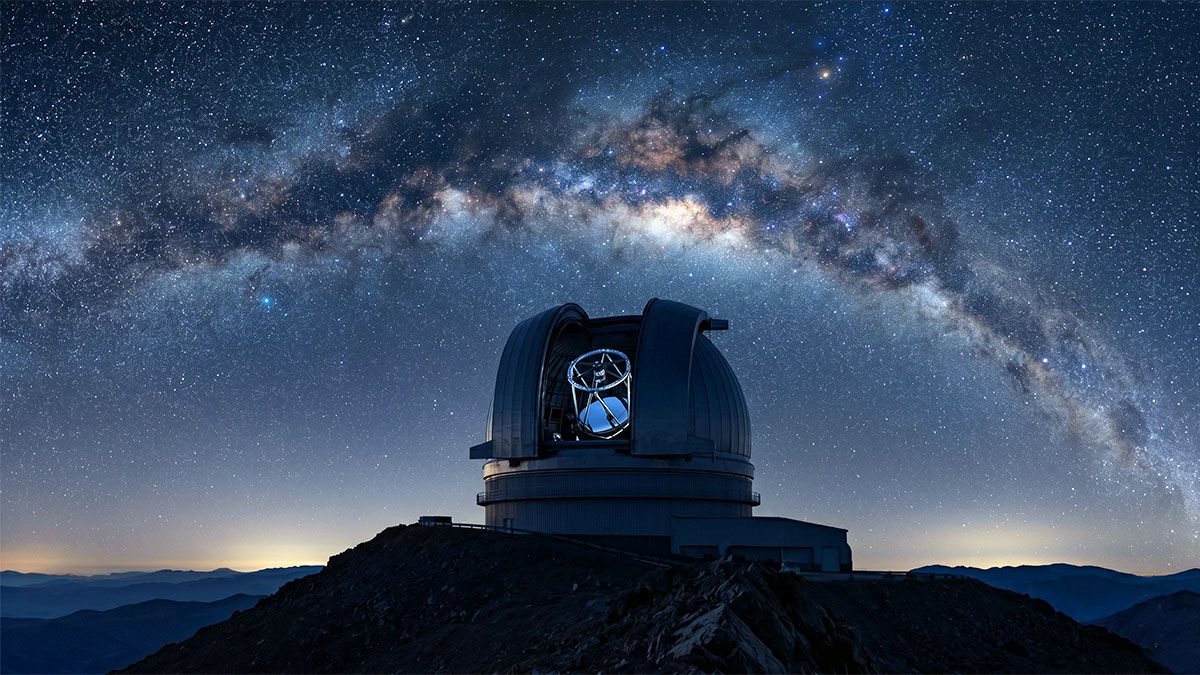
The observatory that now bears her name — the Vera C. Rubin Observatory in Chile, the first U.S. national observatory named for a woman — is built to scan the entire southern sky every few nights. It will generate approximately twenty terabytes of raw data each night. Its design is the culmination of the collapse in the cost of seeing: a facility that can watch everything at once, continuously, with nothing left in the dark. What it will do with everything it sees is still being worked out.
The scan found something. The thing it found was always there. What changed was the price of looking — and nothing about that change made the next question easier. Whether what is visible is worth acting on, how to tell the signal from the noise, whether the measure is tracking the thing it was built to track: those questions were not solved by the machine. They go back to the radar room. They go back to the satellite data flagged as error while the ozone hole was hiding in plain sight. They go back to the galaxy that had been carrying most of its mass invisibly, waiting for someone to measure the rotation curve all the way to the edge.
The bottleneck has moved — from the eye, to the mind. The work now is not seeing more. It is making sense of what is now in view.