Falling Into Step
The same equation that keeps a human heart in rhythm also keeps a national power grid synchronized across thousands of miles — and here is exactly where that identity ends.
The bridge is moving.
Not violently. A gentle lateral sway, barely perceptible at first — the kind of thing you might dismiss as the shift of a crowd around you, or the unevenness of the deck underfoot. London's Millennium Bridge has been open for a few hours on this morning in June 2000, and thousands of people are crossing it, looking out at the Thames, looking at the city.
The natural response to a slight sway underfoot is immediate and instinctive. Widen your stance. Shift your weight. Time your steps to the motion. The body finds its balance without instruction.
Here is what none of those thousands of people on the deck understood: that adjustment was feeding the sway. The slight widening of stance, the unconscious timing of footfalls to the lateral motion, added force to the deck at exactly the frequency it was already moving. More sway prompted more adjustment. More adjustment produced more sway. Within minutes, hundreds of people were walking in unconscious unison — not because anyone organized it, not because anyone noticed they were doing it — because the bridge and the crowd had found each other's rhythm and locked onto it.
The Millennium Bridge closed two days after it opened.
No single person caused this. No engineering failure produced it. The crowd and the structure had done something that turns out to be one of the most fundamental behaviors in the physical world: they fell into step with each other, driven by nothing more than the coupling between them.
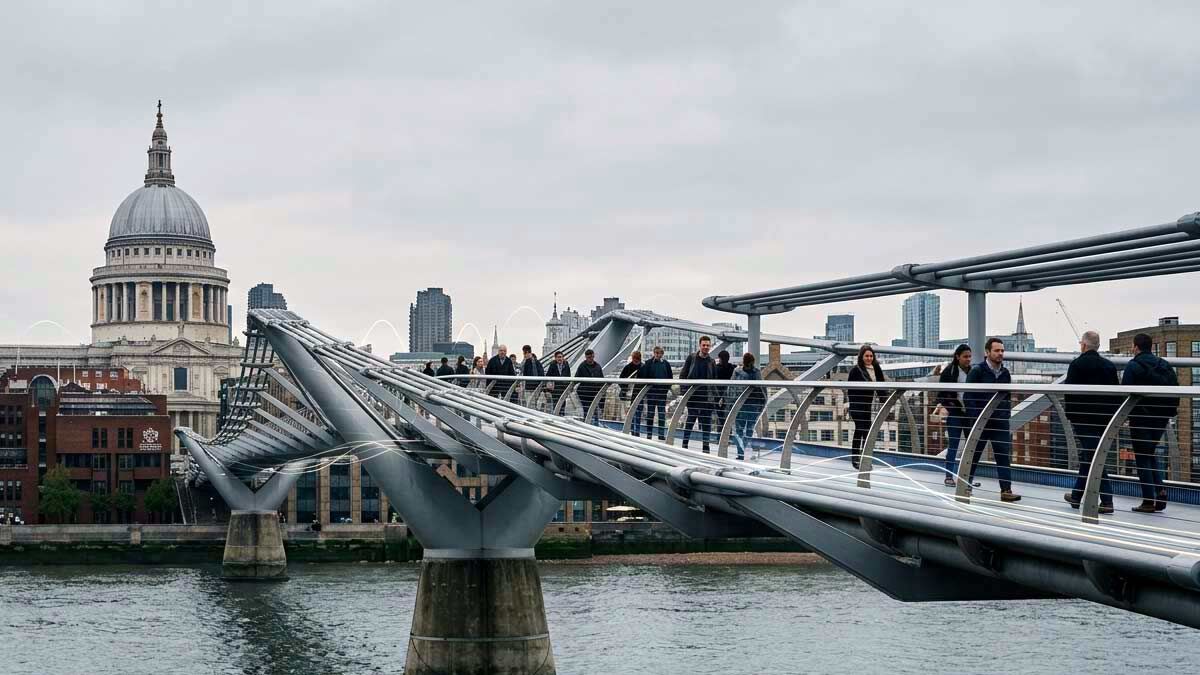
London's Millennium Bridge over the Thames — opened and closed within 48 hours of its public debut in June 2000. No engineering failure. The crowd and the structure had found each other's rhythm.
The Equation Nobody Wrote
What happened on the Millennium Bridge has a name. It is called phase-locking — a condition in which two or more oscillating systems, connected by some medium of coupling, synchronize their rhythms without any central instruction.
An oscillating system is simply something that repeats. A pendulum swinging. A heart cell firing. A bridge swaying. Given enough time and a connection of the right kind, oscillating systems that start at different rhythms will often pull toward a shared one. The coupling medium does not need to be electrical, or chemical, or mechanical. It only needs to transmit a nudge — information that one oscillator's state has changed — at the right moment for the other to adjust.
On the bridge, the coupling medium was the bridge deck itself. Every pedestrian was transmitting their footfall rhythm into the structure. The structure was transmitting its lateral motion back into the crowd's balance response. The loop closed. The rhythm locked.
The equation that describes what happened on that bridge is the same equation that describes a human heart finding its beat.
Not similar. Not analogous. The same abstract mathematical structure — the same variables, the same coupling term, the same measure of how synchronized a population of oscillators has become — appearing in physically unrelated systems and producing physically different behaviors that are, at the mathematical level, the same event.
A Cornell mathematician named Steven Strogatz had been following exactly this connection for years — between the bridge, the firefly, and the heart. His 2003 book Sync named what he had found: not a collection of similar-looking phenomena, but one science of spontaneous order, appearing in different materials. The Millennium Bridge was its most recent and most public demonstration. The biological examples were just older ones.
The Beat That Keeps Itself
Consider what the heart does every second of a human life — not the heart as a pump, but the cells that make it go.
The natural pacemaker of the heart, a small cluster of tissue called the sinoatrial node, is not a single clock. It is a population of individual cells, each one generating its own electrical rhythm, each firing and resetting on its own internal schedule. Isolated in a dish, any one of them would keep its own private time.
Together, they keep one time.
The way to picture this before the mechanism: imagine a room full of people, each holding a metronome running at a slightly different speed. Nobody is conducting. Nobody is listening to anyone else. And yet — if all those metronomes were sitting on the same wooden table, the vibration each one sends through the surface would be felt by all the others. The fastest would slow slightly. The slowest would speed up slightly. Over many cycles, without anyone deciding anything, they would drift toward a shared frequency that none of them had been set to.
This is close to what the cells in the SA node are doing. The coupling medium is not a table but electrical signals transmitted through direct connections between adjacent cells — structures called gap junctions, which allow current to pass from one cell to the next. Each cell's firing nudges the timing of every cell it touches. The nudge is small. Applied across a population, over many cycles, it drives the whole ensemble toward coherence.
In the early 1970s, a theoretical biologist named Arthur Winfree was working on what looked like a narrow problem: what happens when a circadian clock — the biological rhythm that runs on a roughly twenty-four-hour cycle — is disrupted by a brief disturbance? His insight was that the response depended entirely on when during the cycle the disturbance arrived. A nudge at one point advanced the clock. The same nudge at a different point delayed it. He mapped these responses into what he called a phase-response curve — a complete description of how a single oscillator reacts to a perturbation at any moment in its cycle. And he recognized that once you had the curve, you had everything needed to predict whether a population of such oscillators would synchronize or drift.
In 1975, working at Kyoto University, the physicist Yoshiki Kuramoto was trying to solve what looked like a different problem: given a large population of oscillators all interacting with one another, how does collective synchrony emerge? The full many-body calculation was intractable. Kuramoto's simplification was to have each oscillator interact not with every other individually, but with the average state of the entire population — a shortcut that preserved everything important. The model produced a clean prediction: below a critical coupling strength, the population drifts in disorder. Above it, a shared rhythm emerges from the aggregate of all those small mutual nudges.
The SA node operates above that threshold. So do the circadian neurons in the suprachiasmatic nucleus — a small cluster of roughly twenty thousand cells in the hypothalamus that constitutes the brain's master clock. Each cell keeps its own approximate twenty-four-hour rhythm. Together, they synchronize into a single daily signal, through the same class of coupling dynamics, in the same mathematical framework. Different cells, different organ, different timescale. Same equation.
The Signal in the Field
On certain evenings in the forests of Southeast Asia, the fireflies along a riverbank begin to flash in unison.
Not in rough clusters. Not approximately. Together — thousands of insects pulsing as one, the whole bank lighting and going dark in a single beat, the rhythm visible from a distance, sustained through the night without a timekeeper, without a signal source that sits outside the system and sets the pace.
This looks, at first, like it ought to require a leader. A prime firefly somewhere, establishing the beat, and the rest following its signal. But there is no prime firefly. There is only a population of phase oscillators, each responding to the flashes of its neighbors, each shifting its own timing in response to every flash it sees in its field of view.
The phase-response curve of individual fireflies has been measured — the precise description of how a flash seen at a particular moment in one insect's cycle advances or delays its next flash. The governing equation: Kuramoto-type sinusoidal coupling. The predicted behavior: spontaneous synchrony above coupling threshold. The match between the model and the observed riverbank behavior: confirmed.
The firefly swarm is not a curiosity. It is the same mathematics as the SA node, operating outdoors, at night, in a system that evolved the behavior independently and for entirely different reasons.

Synchronous firefly display in Southeast Asia — thousands of individual phase oscillators, no signal source, no conductor. The riverbank lights as one because each insect is responding to all the others.
An Odd Kind of Sympathy
In 1665, the Dutch physicist Christiaan Huygens was ill and confined to his room, watching two pendulum clocks mounted on a shared wooden beam on the wall.
Pendulum clocks were the precision instruments of the moment — Huygens himself had invented the design just years before. These two had been set in motion at different times, at slightly different rates. They should have kept independent time. They should have drifted apart.
They didn't. No matter how many times Huygens reset them to different phases, within about half an hour the pendulums would settle into mirror opposition — swinging in perfect symmetry, one going left as the other went right. He suspected air currents at first. Then, after eliminating air movement, the clocks still locked. The coupling was coming from somewhere else — from the beam itself. Each pendulum was sending a small mechanical impulse into the wood with every swing, and the wood was transmitting it to the other clock. He wrote to the Royal Society describing what he had observed. He called it an odd kind of sympathy between the clocks.
He had no framework for what he was seeing. The equation explaining it was three hundred years away. What he had, and recorded with scientific precision, was the coupling. The pendulums were talking to each other through the structure between them — and the conversation always arrived at the same conclusion.
The anti-phase locking Huygens observed — clocks settling into mirror opposition rather than unison — is precisely what the phase-oscillator mathematics predicts for two coupled oscillators of nearly identical frequency sharing that specific type of mechanical connection. The beam's geometry determined the outcome. The outcome was not a coincidence. It was the only stable solution the equations permitted.
Huygens noticed it in 1665. The equation that explains it was written in 1975.
The Same Equation on Purpose
For most of the history documented above, synchronization was something nature produced without being asked. Then engineers started asking for it.
Once the Kuramoto framework was in hand, the question became: what happens when you intentionally couple oscillators the way the SA node and the firefly swarm do it without planning to? The answer turned out to be useful enough to build with.
A Wien-bridge oscillator is a simple electronic circuit that generates a clean, stable sine wave. Connect several of them through a coupling circuit, and they phase-lock — exactly as pendulums do through a shared beam. In experimental work with such networks, the phase trajectories measured from the voltage signals matched the Kuramoto equations with quantitative precision: not approximately, but in specific, measurable detail as coupling strength was varied. The oscillators weren't behaving like Kuramoto systems. They were Kuramoto systems.
Josephson junction arrays — devices that generate oscillating electrical current at the boundary between classical and quantum physics — show the same behavior. Arrays of them lock their phases through electromagnetic coupling, and the coherent output scales with the number of junctions. Laser arrays do the same: coupled emitters lock their phases through shared optical fields, producing output more coherent than any single emitter could achieve alone.
These engineers did not start from firefly biology or cardiac physiology. They arrived at the same equations because those equations describe a class of behavior — weakly coupled, self-sustaining oscillators — that is determined by the coupling structure, not by what the oscillators are made of. The physics does not distinguish between a firefly, a cardiac cell, and a superconducting junction. When the conditions hold, the equation governs all of them.
The Continent on a Wire
The electrical grid serving a continent is the largest synchronized machine ever built.
The concrete reality of that: hundreds of generators — gas turbines, nuclear plants, hydroelectric dams, wind farms — spinning at different physical locations, connected through thousands of miles of transmission lines. Every generator in a synchronized grid runs at the same frequency. Not approximately the same. The same. Every rotor completes its cycle in lockstep with every other, across distances that would take days to drive, with no central clock sending out a timing signal and no conductor telling each machine when to turn.
What holds this together is coupling through the transmission network itself. When one generator speeds up slightly — responding to a local surge in demand, or a gust that briefly spins a turbine faster — the phase difference between it and the rest of the grid creates a restoring force that pulls it back toward the shared frequency. No human intervention required. No central command. The coupling produces coherence.
The mathematics governing this is a second-order variant of the Kuramoto model that incorporates the mechanical inertia of spinning generators. The equations have been used explicitly to analyze synchronization stability in the European transmission grid, and to model the conditions under which synchrony breaks. The order parameter that measures how synchronized a population of fireflies is — the ratio of locked oscillators to total oscillators, from zero to one — is the same order parameter used to measure how close a national power grid is to losing coherence at any moment.
When a grid loses synchrony, the consequences cascade. The 2003 Northeast blackout began with a software error and a sagging transmission line in Ohio; within minutes, the failure propagated to the Atlantic coast. That event is now a case study in critical coupling failure: the grid fell below the synchronization threshold in one region, and the cascade spread faster than any human operator could intervene.
The same mathematics. Different scale by twelve orders of magnitude. Same critical threshold. Same order parameter. Same consequence when the coupling fails.
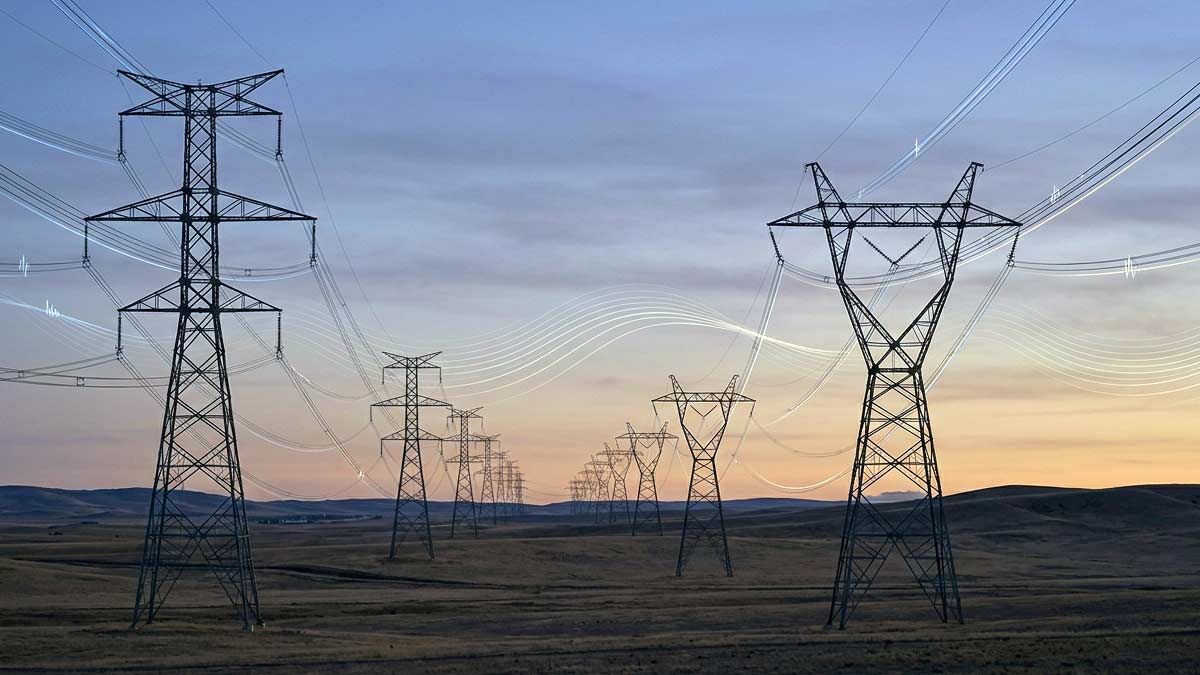
High-voltage transmission lines carrying synchronized alternating current across a continent. The same order parameter that measures firefly synchrony measures grid coherence — and the same threshold governs both.
As Far as the Sun
The question worth asking here is how far the equation actually reaches — not how far the analogy could be pushed, but how far the literal identity holds.
The Sun's activity is not uniform across its surface. The northern and southern hemispheres show measurable asymmetry in magnetic activity, cycles that drift in and out of phase with each other across the decades. In 2017, solar physicists modeled this hemispheric behavior using a Kuramoto-type framework: treating different latitude bands and activity centers as phase oscillators with sinusoidal coupling, and using the standard Kuramoto order parameter to track how synchronized the hemispheres are across solar cycles.
This is a genuine application of Kuramoto-class dynamics at stellar scale. The model fits observed solar behavior. The order parameter tracks the data.
But the language matters here, and it matters precisely. The Sun is not a Kuramoto oscillator. It is modeled as one — at the level of its observable magnetic patterns — by researchers using the simplest framework that captures the behavior. Whether the Sun's underlying plasma physics actually satisfies the conditions that justify the phase-oscillator reduction has not been established from first principles. The model is phenomenological: it works at the level of what can be observed and measured on the solar surface. The derivation from the microphysics has not been closed.
That is the ceiling.
Beyond it — pulsars, accretion disks, neutron star oscillations, the large-scale structure of galaxy clusters — the resemblance to Kuramoto-class synchronization breaks down not gradually but categorically. These systems oscillate. They resonate. Some of them show behaviors that, described loosely, sound like synchrony. But the governing equations are Hamiltonian orbital dynamics, general relativistic hydrodynamics, gravitational N-body systems — a different mathematical family entirely, with different conserved quantities, different stability conditions, different solutions. Applying the synchronization framework past the solar ceiling is not an extension of the pattern. It is a substitution of a different thing that has been given the same name.
The honest stop is not a limitation of the pattern. It is the pattern's most precise statement.
Falling Into Step
Return to the bridge.
The Millennium Bridge reopened in 2002, after engineers installed fluid-viscous dampers throughout the structure — devices that absorb lateral energy before the feedback loop can build. The fix worked. Tens of thousands of people cross it every week now without feeling anything unusual.
But the coupling is still there. The pedestrians are still transmitting their footfall rhythm into the deck. The deck is still responding. The same physics that closed the bridge operates every time anyone walks across it, held just below the threshold at which it would lock.
There is something worth sitting with in that. These are not systems observed from a safe distance, in a laboratory, behind glass. The SA node cells keeping a heart in rhythm, the circadian neurons setting the body's daily clock, the generators synchronizing across a continent — these are the infrastructure of the world as it exists right now, operating continuously, holding coherence through coupling rather than command. The crowd on the Millennium Bridge did not choose to synchronize. The choice was never available to them. The coupling was available to them — the shared deck, the shared oscillation, the feedback between their balance and the structure's response — and the mathematics did the rest.
Synchronization is not a property of any single element in these systems. It is a property of the relationship between them. Change the coupling, and the rhythm changes. Remove it, and each oscillator returns to its own private time.
What Huygens called sympathy, what the engineers on the Millennium Bridge called positive feedback, what Kuramoto called a phase transition — they are the same observation, made centuries apart, in systems that share no material, no scale, and no visible resemblance.
Only the equation.