Plants Don't Have Brains — So How Do They Remember?
A bare tree in December looks like it is doing nothing. It is actually counting — keeping a chemical record of every cold day, written into the architecture of its cells.
The tree outside your window in December is doing absolutely nothing.
That's what it looks like, anyway. No leaves. No flowers. No movement. The branches are stripped down to bare wood. The buds are sealed up tight against the cold. By every ordinary measure, this is a tree on pause — life pressed against its own off switch, just waiting for spring to flip it back on.
That picture turns out to be almost completely wrong. Inside that motionless tree, something extraordinary is happening right now, in the dead of winter. The tree is counting. It is keeping track of every cold day that passes, in a chemical ledger written directly into its cells. And when spring finally arrives, the tree will not respond to the warmth alone. It will respond only if the count is right.
Plants don't have brains. They don't have nerves. They don't have anything that looks like a memory by the usual definition. And yet they keep track of winter. They read the angle of the sun. They feel the wind on their leaves and the pressure of a neighbor's roots in the soil. They send chemical warnings into the air and rewrite the chemistry of the dirt around them.
None of this is metaphor. All of it is measurable. And the more closely scientists look, the stranger the picture gets.
It is counting.

Counting the Cold
The reason a tree needs to count winter at all is a matter of survival.
If a fruit tree blooms during a warm week in January, it will lose its flowers when the next frost arrives — and with them, its entire chance to reproduce that year. Temperature alone is not a reliable signal. A few warm days in midwinter mean nothing. What matters is whether enough cold has actually accumulated to indicate that winter is genuinely over. The tree needs a way to track the duration of the cold, not just its presence.
Without a brain, where does that count get stored?
The answer is written directly into the tree's DNA, and the mechanism is one of the most surprising discoveries in modern plant science. It has a name — vernalization — and it works something like an encryption process running silently inside every cell.
Imagine an important file on a computer that needs to stay locked until the right moment. You could protect it with a password. Better yet, you could add a new layer of encryption to it every week — so that by the end of January, the file has been encrypted ten times, and by the end of February, twenty. The longer the cold continues, the harder the file gets to open. When spring arrives, the file is so heavily locked that the cell can no longer read it at all. And that is precisely when the tree is finally cleared to bloom.
The actual mechanism works on a gene called FLC. As long as FLC is active and readable, the plant cannot flower — the gene functions as a hard brake on the whole system. But during prolonged cold, the molecular packaging around FLC begins to tighten. Inhibitory marks are laid down across the gene, week by week, each one making it harder for the cell's machinery to access. By the time spring arrives, the gene is buried under so many layers of suppression that it can no longer be read. The brake releases. The flowers come.
The cold was not just endured. It was recorded.
And here the question shifts in a way that catches most readers off guard: is this memory?
The honest answer is that it depends on what memory means. Human memory involves recollection — an inner image, a stored event, a moment recalled. None of that is happening inside the tree. There is no mental picture of winter. No narrative being retrieved. What persists is something different: an altered physical state. The tree that enters spring is not the same tree that entered winter. Its cells have been physically changed by what they passed through, and those changes determine what the tree does next.
That is a working definition of memory at the most basic biological level — a prior condition carried forward as altered readiness.
It was encoded.
The Plant Reads
If the tree is keeping a winter ledger, it is also reading something else, all the time, in real time. The light.
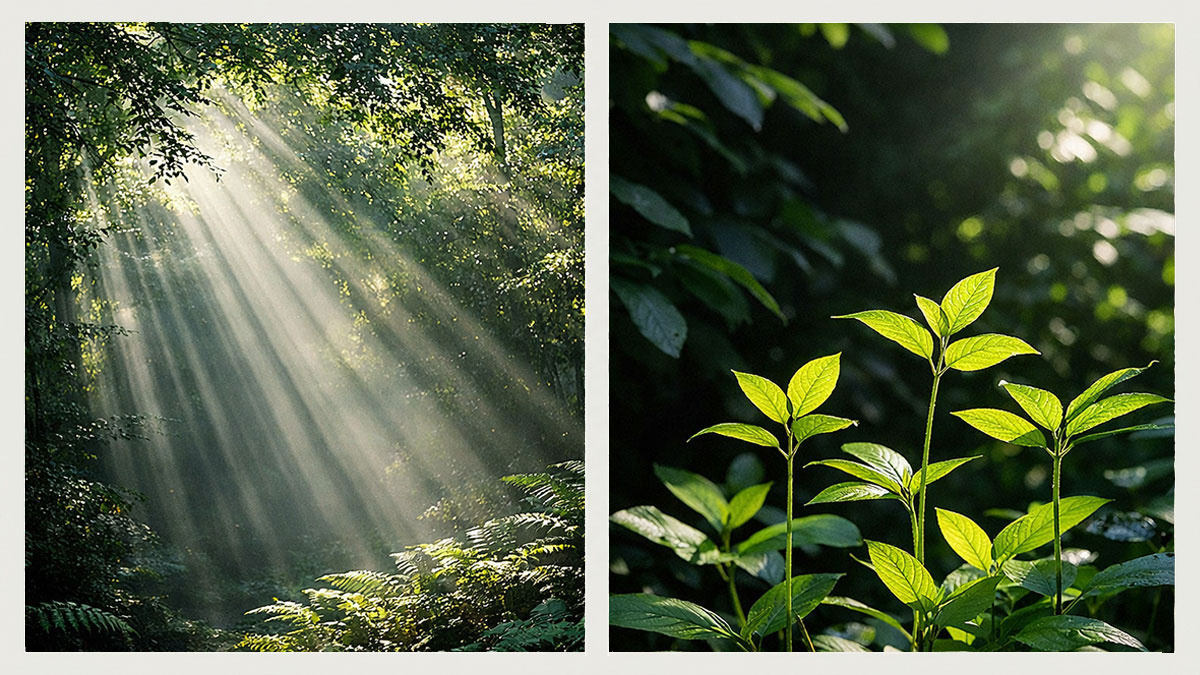
A houseplant placed near a window doesn't bend toward the sun simply because it likes the warmth. It is processing the light as a continuous stream of structured information — far richer than what human eyes pick up. Every leaf surface is functioning as a kind of biological antenna, tuned to specific frequencies of the electromagnetic spectrum, reading the world through chemistry rather than through any organ that could be called an eye.
One family of these antennas is called phytochromes, tuned to red and far-red light. Plants absorb red light to power photosynthesis, but they let far-red light pass right through their leaves — which means far-red is not useful as fuel. It is, however, extraordinarily useful as information.
Suppose a small plant is growing on a forest floor. If its phytochromes detect a high ratio of far-red light hitting its sensors compared to normal red light, the plant can deduce something specific: the red light has already been filtered out by leaves above it. There is a competitor up there, casting shade. The plant is not just sitting in dimmer light. It is recognizing the chemical signature of another plant blocking its access to the sun. And in response, it adjusts its growth — investing in vertical reach to escape the shade rather than spreading sideways.
That is one channel. There are others. A second family of receptors, called cryptochromes, responds to blue and ultraviolet light, and these track something different again — the angle, intensity, and duration of daylight. By continuously sampling blue light, the plant can calculate not just where it is in the day but where it is in the season. It calibrates its internal clock against the sky.
None of this looks anything like vision. There is no image being formed, no scene being witnessed, no observer behind the leaves. But information is being extracted continuously, from every square inch of plant surface, at a level of detail that human eyes cannot match.
It reads.
The Sense Without Nerves
Light is the obvious channel. Touch is the strange one.
The Mimosa pudica is the famous example — the dramatic plant whose leaves fold up in seconds when a finger brushes them, as if recoiling from contact. The performance is theatrical and well-known. What is less known is that an ordinary tomato plant, an oak tree, a fern, or any other green thing in a garden is doing something remarkably similar. It just doesn't put on a show.
Every plant surface functions as a mechanically responsive membrane. The pressure of a neighbor's root pressing against a stem. The impact of a heavy raindrop. The bending force of the wind on a branch. All of it registers — physically, cellularly, immediately. And the question is the same one that came up with light: how does this work without nerves? A plant is essentially a network of fluid-filled cells. How does a cell wall feel anything?
The mechanism is something like a stadium wave. When a leaf bends in the wind, the stretching of the cell membrane physically pulls open tiny gates embedded in its surface. Through those gates, calcium ions rush from outside the cell into its interior. That sudden influx changes the cell's chemistry — and the change triggers the next cell, and the next, the way a section of a stadium crowd standing up triggers the section beside it. A wave of chemical signal travels outward through the plant's tissues, carrying information from one part of the organism to another in seconds.
What started as a single bent leaf becomes a system-wide event. The plant responds by altering its growth — reinforcing the stem, thickening the cell walls, bracing against future stress. It is continuously sampling physical force across its entire body and adjusting its architecture in response.
This is not nerve signaling, and the plant has no central place where the signals converge. There is no equivalent of a brain reading the input. The reading happens locally, everywhere at once, through chemistry. And it works.
The Sound of Failing Plumbing
If a plant can feel a raindrop, what happens when it is pushed past the limit of what it can handle?
Researchers placed sensitive microphones near tomato and tobacco plants, then deprived some of water and physically injured others to simulate severe drought and damage. What the microphones picked up was startling: the stressed plants were producing rapid, ultrasonic clicking sounds. The clicks were too high-pitched for human ears, but the patterns were measurable, and they varied depending on what kind of stress the plant was under. A plant dying of thirst sounds different from a plant that has been cut.
The temptation here is to imagine the plant crying out — calling for help, expressing distress. The reality is more interesting and more mechanical, and understanding it requires a brief look at how a plant moves water at all.
Inside every plant is a system of microscopic tubes called the xylem. These tubes pull water up from the roots to the highest leaves, sometimes against significant gravity, and they do it through tension rather than pumping. As water evaporates from tiny pores in the leaves, the column of water below is pulled upward — held together by the way water molecules cling to each other, like a continuous thread being drawn through the plant.
The closest familiar version of this is trying to drink a thick milkshake through a flimsy paper straw. The harder you pull, the more tension builds inside the straw. At some point, the liquid can't hold together against the suction. An air bubble suddenly shoots up the column, the flow snaps, and the straw makes a small popping sound — or the whole thing collapses. That is, almost exactly, what is happening inside a drought-stressed plant.
The tension in the xylem builds as the soil dries and the leaves keep losing water to the sun. Eventually, somewhere in the network of microscopic tubes, the water column cannot hold its cohesion any longer. It snaps. A tiny air bubble forms — the technical name is cavitation — and the snap releases a microscopic pulse of acoustic energy. A click. When thousands of these snaps occur during a severe drought, they produce a continuous acoustic signature that microphones can pick up.
The plant is not crying. The plant is its plumbing failing under stress. But the sound is real, and it carries genuine information about the plant's condition. Researchers are still studying whether neighboring plants or insects have evolved to detect these acoustic signatures and respond to them. The forest, it turns out, is far noisier than human ears have ever suggested.
The Underground Reach
So far, the picture is of a plant constantly sampling the world through its surfaces — light, touch, internal stress. But the plant's reach extends further than its body. It extends into the soil and into the air, and in both directions, the chemistry it pumps out is doing something closer to engineering than to passive existence.
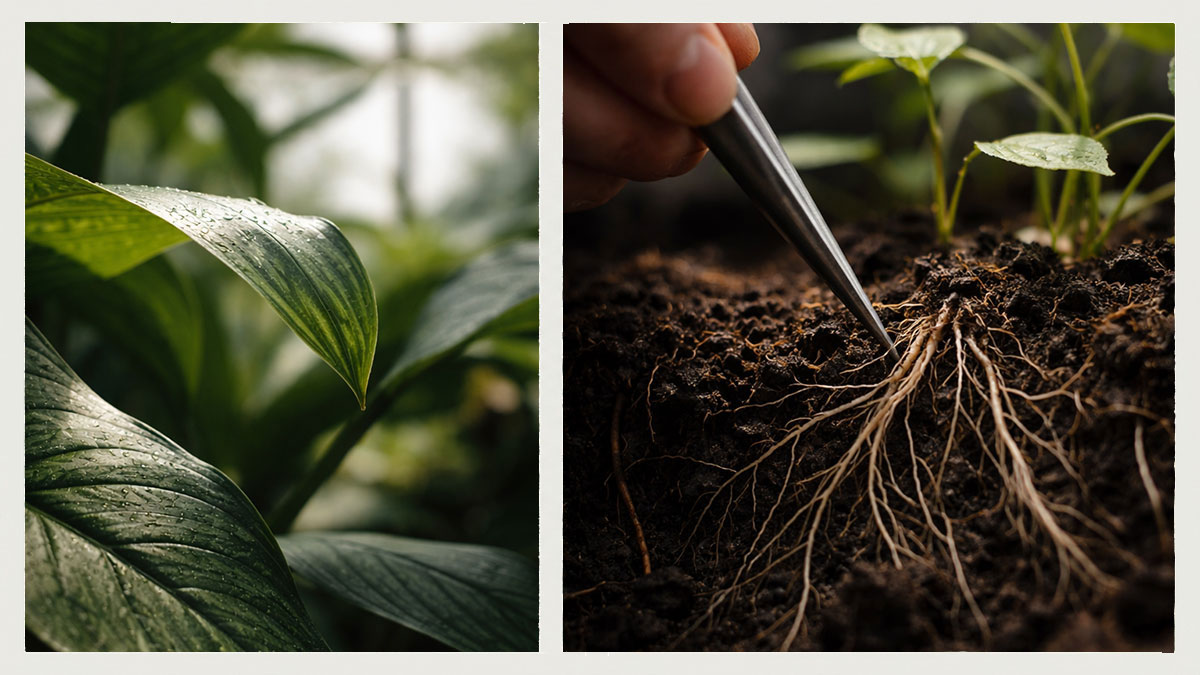
Roots are the obvious starting point. They are usually pictured as straws, drinking water and minerals from the dirt. But roots also continuously release a complex mix of compounds called root exudates — sugars, organic acids, enzymes, specialized molecules — flooding the soil immediately around them with chemistry the plant is choosing to produce.
Why would a plant spend energy giving away resources?
Because the soil it secretes those compounds into stops being neutral dirt and starts being a managed environment. If a plant needs phosphorus that is locked up in a mineral form it cannot absorb, it can secrete a specific acid that dissolves the mineral and frees the nutrient. If it is being attacked by a soil-borne disease, it can release sugars that attract bacteria capable of hunting that disease. The plant is not just sitting in the soil. It is rewriting the chemistry of the soil to favor its own survival.
Above ground, the same kind of chemical reach extends into the air.
When a plant is being eaten by a caterpillar, it doesn't just sit there and lose tissue. It releases a plume of volatile organic compounds — airborne chemicals — into the atmosphere around it. These are not random distress signals. They are structured, specific to the kind of damage being done, and they drift on the wind to nearby plants. The neighboring plants detect those compounds through their own surfaces, and they begin altering their internal chemistry before the insects even reach them. Bitter tannins start accumulating in their leaves. Defensive proteins start being produced. By the time the caterpillars arrive, the next plant is already prepared.
Whether this should be called communication is a question the science is still working out. The plant releasing the compounds isn't deliberately sending a message in the way an animal might call to another. But the signal is real, the response in neighboring plants is measurable, and the result is a kind of preemptive defense network spreading across a field through the air. The chemical alarm travels faster than the caterpillars can.
Its influence does not.
A Word Problem
By this point, the language used to describe what plants do starts to strain.
Memory. Vision. Touch. Communication. These are all words built around how animals work — and animals share a common architecture of brains, nerves, sense organs, and conscious intention. Humans diverged from plants more than a billion years ago, and the equipment we evolved to navigate the world is utterly different from the equipment plants evolved to navigate theirs.
So when a plant tracks the duration of cold without a nervous system, is that memory? When it reads the ratio of red to far-red light without eyes, is that vision? When it releases volatile compounds that change the behavior of neighbors, is that communication? The strict animal definitions say no. But retreating into those strict definitions creates a problem of its own — it forces a conclusion that plants are essentially passive, doing nothing of consequence, when the evidence is that they are doing an extraordinary amount.
The honest position is somewhere in between. A plant releasing chemical signals into the air is not having a conversation in the way two people are. But it is engaged in a structured exchange of information that alters the behavior of a receiver. A plant reading far-red light to detect a competitor is not seeing in the way a human sees. But it is certainly not blind, either.
The picture of the passive plant — quietly photosynthesizing in the background while animals do all the real living — was never actually a scientific discovery. It was a limit in how humans were looking. The molecular signaling, the chromatin remodeling, the calcium waves, the volatile compounds, the underground chemistry — none of it was visible to the unaided eye. As soon as the right instruments arrived, the picture changed completely.
It was a limit in how we were looking.
A Tree, in Spring
Return to the tree outside the window. It is early spring now. The same buds that sealed themselves shut against December are beginning to open. A small trace of green appears at the edge of the branch, then another, and within days the tree has leaves again.
From the outside, this looks like a tree doing what trees do. The temperature rose, the sap rose, the leaves came out. Easy to miss.
But the visible moment is only the end of a much longer process. The cold was counted. The light was read. The tissues changed. The chemistry shifted. The readiness accumulated, slowly, all winter, in a thousand cellular ledgers running in parallel through the dark months. The tree did not need a brain to do any of this. It needed a system capable of receiving signals, retaining traces, and altering future behavior — and the system it has, evolved over hundreds of millions of years, is good enough to track an entire winter without anyone noticing.
And here is where the question gets larger.
If memory does not require a nervous system — if it can be written into the molecular architecture of a living thing as readiness, as altered state, as encoded prior condition — then what else in the world around us is remembering, in some form, all the time?
The soil under a forest is full of chemical traces left by generations of roots. The air above a grassland carries volatile signals released by plants that lived there last summer. The tree rings in a piece of old wood preserve the climate of every year that tree lived through. None of these are memories in the human sense. But none of them are nothing, either. They are records, written by living systems into the chemistry of the world, waiting to be read by whatever can read them.
The tree in December was never still. It was working at a scale the eye could not follow, in a language biology is still, a billion years later, only just beginning to translate.