How Two Bodies Learn to Move as One
When people move together — dancing, singing, rocking a baby to sleep — the coordination goes deeper than anyone suspected. Science has started measuring what happens underneath.
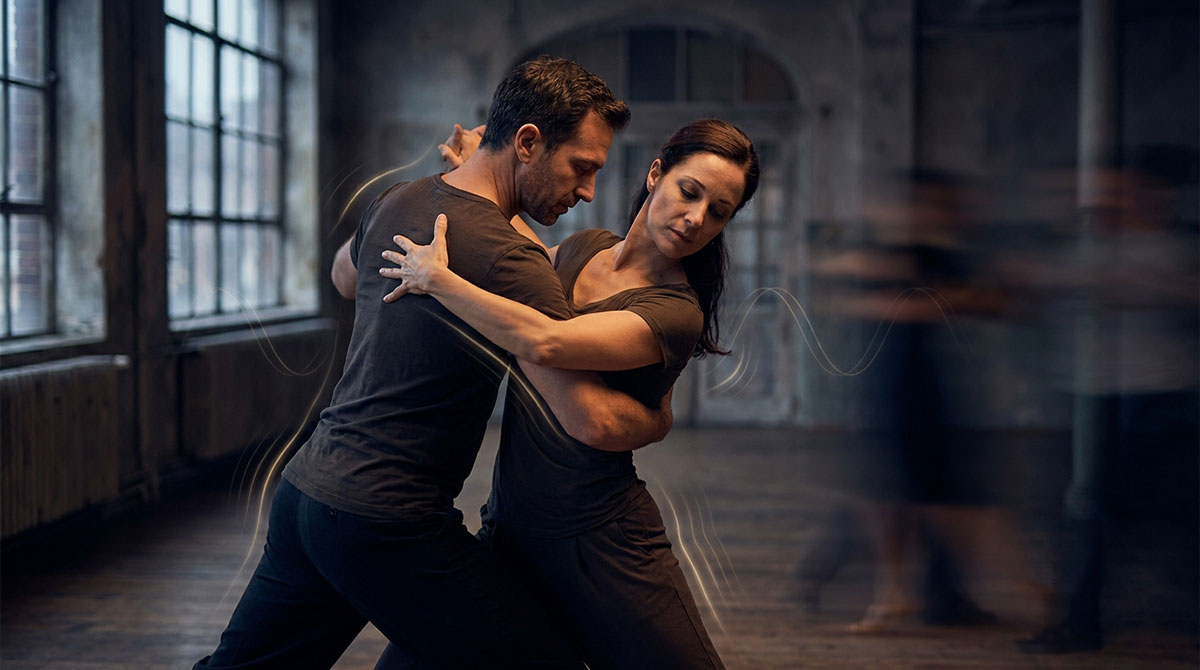
Two dancers move without speaking.
One body shifts weight. The other answers. A foot slides, a torso turns, a pause opens, and the next step arrives as if both people had heard the same instruction at the same moment — except no instruction was given.
Here is the part that turns out to be strange: the coordination may not stop at the surface. When scientists fitted dancers with equipment to measure their brain activity while they moved together, the patterns coming from two separate skulls began to look like each other. Not identical. Not merged. But measurably similar — pulled toward the same timing in a way that would not have appeared if the same dancers were moving alone. Their bodies had found a shared rhythm. And that rhythm, it turns out, had reached in.
Not one mind. Not merged consciousness. Something quieter — and much, much older than language.
The timing reached deeper.
The Dance Before Words
Dance is not a solo brain solving a solo task. It is a moving exchange — two bodies in continuous negotiation, each reading and adjusting, each creating the conditions the other responds to next.
Think of a game of catch played between two people who know each other well. Nobody calls out where the ball is going. Nobody announces when to throw or when to reach. The exchange runs on a kind of silent fluency — built from timing, prediction, and the accumulated learning of many throws. The body of one person is anticipating the body of the other, continuously, a fraction of a second ahead of every action. The game is a loop, not two separate solo performances happening at the same time.
What modern neuroscience has begun to ask is what that loop looks like when instruments can watch two nervous systems at once. The tool it reached for is called EEG hyperscanning — equipment that records brain activity from two people simultaneously, letting researchers watch neural patterns in both participants at the same moment, like watching the wiring of two buildings during a shared power event.
In studies of experienced tango dancers fitted with mobile EEG equipment, the finding was this: when leader and follower moved more tightly in step, their brain wave patterns became more similar. The strongest coupling appeared when movements aligned within a fraction of a second — faster than either dancer could have narrated it. Their nervous systems were, in a measurable sense, organized around the same event at the same time.
This does not mean dancers become one brain. Each body is still making its own adjustments. Each dancer is still separate. But the event is shared. The beat is shared. The next motion is being anticipated from both sides at once — and that shared anticipation leaves a trace that instruments can see.
Synchrony is not sameness.
It is ongoing adjustment.
not disappearance.
Three Depths, One Word
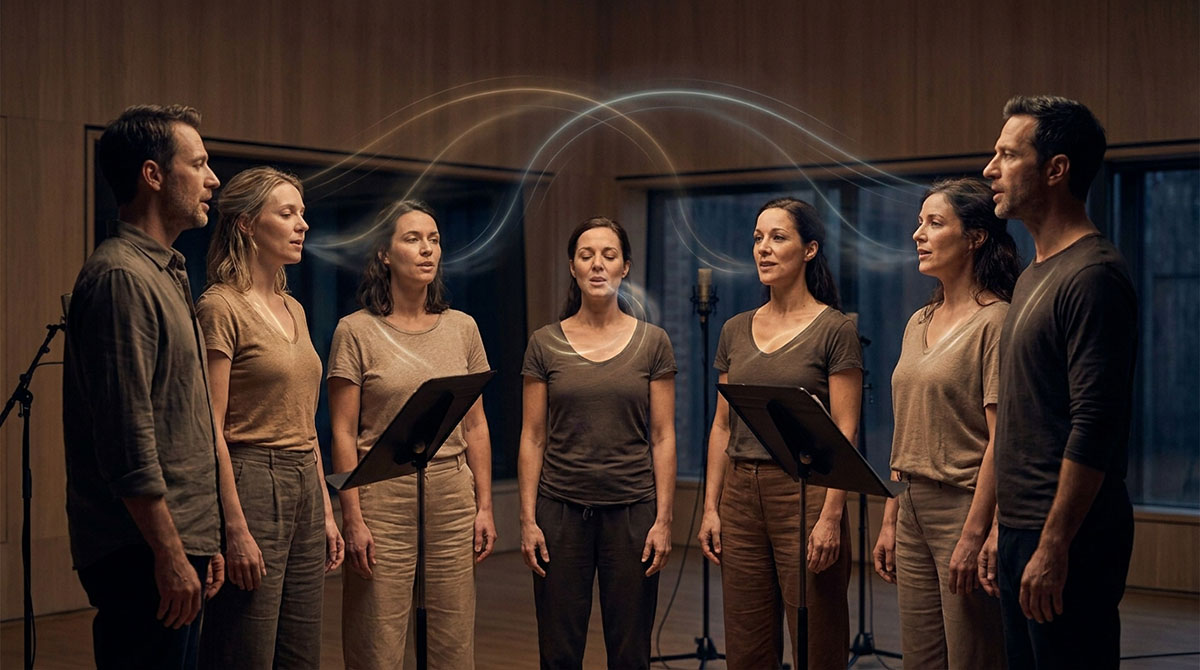
Watch a choir move through the final bars of a phrase.
Something like Russian nesting dolls is happening — three layers of coordination stacked inside each other, each one invisible from the previous level.
The outermost layer is the one the eye can follow. Bodies lean slightly, shoulders drop, breath drops with them. The movement matches across many people simultaneously. A person standing at the back of the concert hall can see it without any instruments at all.
Open that layer and there is another inside it. As singers move through the same phrase, their breathing follows the same arc. Lungs fill at the same moment. Hearts, slightly drawn by breath, begin to pull toward the same rhythm. This alignment is invisible from outside — measurable only by the kind of equipment research teams now bring into rehearsal spaces. A different layer entirely, interior rather than visible, bodily rather than behavioral.
Open that layer and there is a third. In studies of musicians performing together, brain signals show coordinated patterns around shared timing — the moment a phrase begins, the moment it resolves. The nervous system of one performer partially coupling to the nervous system beside it. This is the hardest layer to measure and the most easily overstated. It is also the most recent to be documented.
Three layers. None of them the same mechanism. None of them automatically present when the others are. A flock turning in the sky can show the outermost layer without any of the rest. Two people in quiet conversation may draw into physiological alignment — heart rates pulling toward each other across an hour — without any of the neural coupling EEG measures. And the layers can appear in combinations that don't follow obvious rules.
The word synchrony covers all of it. That is why it needs handling with care. Seeing bodies move in unison and concluding that minds have merged is a long leap from the evidence. So is dismissing the phenomenon because the outer layer looks so ordinary.
Which one is speaking matters.
A Shared Clock
Music makes the pattern easier to hear — partly because music is, at its core, a technology for synchronizing bodies.
Before music becomes performance, it is coordination. A duet requires shared tempo. A drum circle requires pulse. A choir requires breath, phrase, and entry timing. Each participant must monitor the sound, the body, the group, and the moment that is about to happen — all at once, all the time.
Think of what happens when several old pendulum clocks hang on the same wall. Left alone for a day, they tend to pull each other into phase — their swings gradually aligning until they tick in unison. No one clock is in charge. No instruction is passed between them. The alignment happens because each pendulum's vibration travels through the wall and nudges the others, and over time the nudges accumulate into coordination. Physicists call this entrainment. The clocks have found a shared rhythm not by agreeing to, but by existing in the same medium and responding to the same signals.
The body does something similar when placed inside a musical beat. The song tells the body when to breathe. The breath influences the heart. The heart, drawn by breath, begins to align with other hearts following the same phrase. In studies of choirs, researchers have found that singing together can pull breathing and heart-rate variability into coherence — particularly when singers move through the same phrases at the same time. The mechanism is not mystical. It follows from shared timing, shared breath, and bodies responding to the same cues in the same moment.
Rhythm is not decoration added to music after the fact. Rhythm is one of the ways bodies solve the problem of acting together without constant verbal instruction. The beat becomes a kind of temporary agreement. It reduces uncertainty. It tells the nervous system when to prepare, when to release, when to enter, when to wait.
Music does not erase individuality. It does not create a single group mind. It gives many individuals a shared clock — and shared clocks, it turns out, are one of the oldest technologies life has ever developed.
it is bodies sharing time.
Before Words
Synchrony does not begin on the dance floor.
It begins earlier. Much earlier.
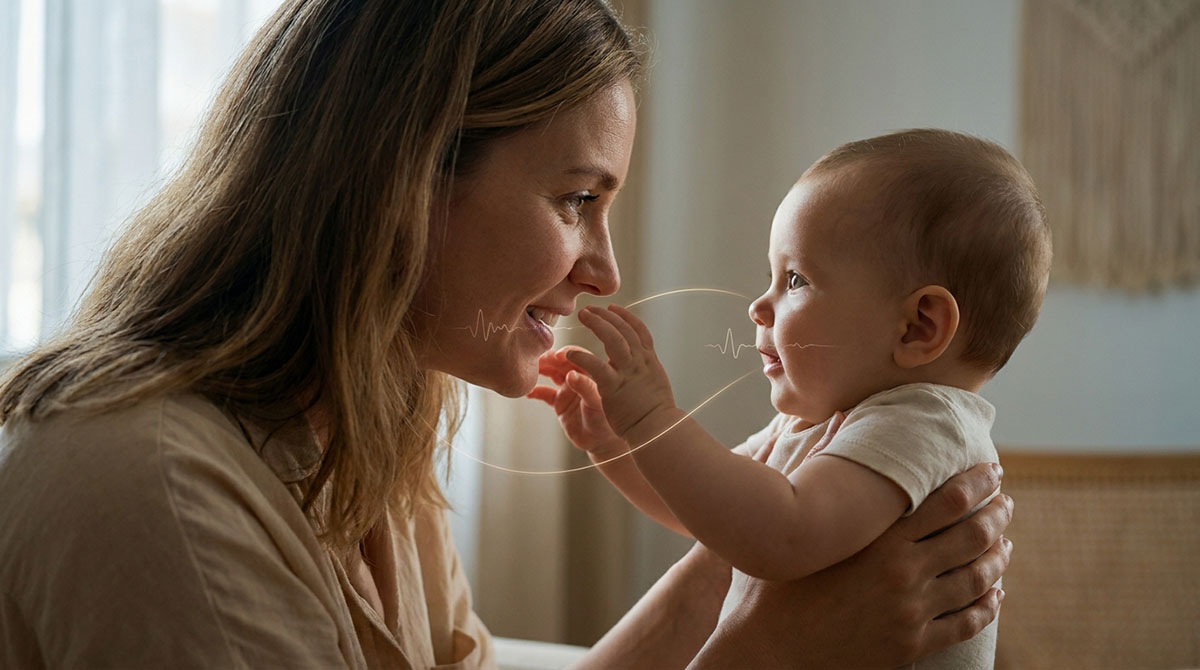
Before a child understands words, relationship is already arriving through rhythm. A caregiver leans close. An infant looks, looks away, returns. A coo is answered. A pause opens. A smile appears. A voice rises and softens. A hand rocks the body until breathing slows.
This is not language yet. But it is already communication — and here is what makes it stranger than it first appears. The infant is not passively receiving the rhythm. The infant is helping to generate it. What looks from the outside like a caregiver calibrating to a quiet, unresponsive baby is, at the level of the exchange, something more mutual. Two nervous systems, one of them barely weeks old, finding their timing together.
Think of the early radio operators who communicated in Morse code across distances — two people who had never met, sending and receiving, adjusting their speed to match the other, developing a rhythm over hours of exchange that was unique to that pairing. Neither was in charge. The timing was negotiated, transmitted, and rebuilt with each exchange. The coordination was real — measurable in dots and dashes — but it existed between them rather than inside either one alone.
What has been measured beneath caregiver-infant moments works something like that. Heart rhythms between caregivers and infants draw into alignment during face-to-face play — particularly during eye contact, shared vocalization, and moments of mutual attention. Vocal turn-taking begins in the first months of life, long before there are words to fill the turns. Brain activity in caregiver-infant pairs shows coordinated patterns during gaze, shared sound, and call-and-response. The exchange is already organized. It is already timed. The nervous systems involved are already finding each other across the gap between two separate bodies.
Synchrony, in this earliest form, is not perfect attunement. Healthy interaction includes mismatch and repair. The caregiver misses a cue, then returns. The infant turns away, then re-engages. The rhythm breaks, then finds itself again.
Relationship is not built from constant harmony.
It is built from response.
relationship was already timing.
Brains in Company
The same larger theme appears beyond humans — though it needs careful handling.
Animal studies cannot be treated as simple mirrors of human dance, music, or language. A mouse interaction is not a tango. A bat colony is not a choir. Species matter. Context matters. Mechanism matters. What can be said is this: the finding keeps arriving.
Two tuning forks tuned to the same pitch, placed near each other in a quiet room, will start to reinforce each other's vibration. Strike one and the other begins to hum — not because anything was sent from one to the other, but because both are built to resonate at the same frequency, and the air between them carries enough information for each to respond. The mechanism is ordinary physics. The result looks, from outside, almost like communication.
In studies of mice, researchers have recorded brain activity from pairs of animals during social interaction. Neural activity in prefrontal regions became more coordinated during direct social engagement, and the synchrony was linked to future interaction patterns and social hierarchy. In Egyptian fruit bats, researchers have recorded coordinated neural patterns during social proximity — patterns tied to vocalization and context that appeared stable enough to suggest the signals were not simply momentary reactions to noise.
The safe conclusion is modest but genuinely important: animal brains can become coordinated during social interaction. This does not mean animals share thoughts. It does not mean synchrony equals affection or that every species uses the same mechanism. It means that nervous systems are often built for social timing. They do not only process the world as a series of isolated objects. They process other bodies, other signals, other calls and movements — and those other bodies process them back.
The brain did not evolve outside social life.
It evolved inside the exchange.
It was built by solving them.
A Choreography Without a Choreographer
At the widest scale, synchrony no longer requires two brains looking at each other.
It can appear as collective movement — and when it does, it produces one of the most persistently astonishing things in the natural world.
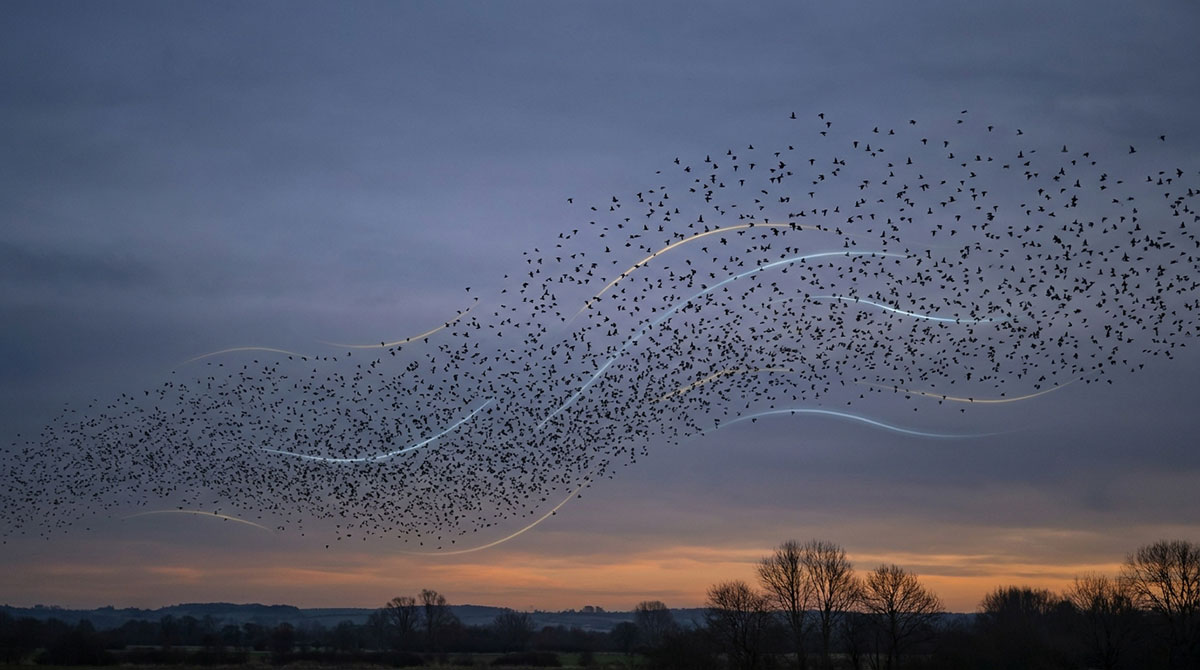
A flock of starlings turns in the sky, folding and unfolding like smoke. A school of fish splits around a threat and reforms. Fireflies flash in waves across trees. Crickets adjust their calls around other crickets until a whole meadow begins to pulse. These patterns look as if one mind is controlling the group from somewhere above it. But the mechanism is almost exactly the opposite of that.
Think of the way a rumor travels through a crowd. Nobody announces it from a stage. Nobody coordinates the spread. Each person hears it from someone nearby and passes it to the person beside them. The pattern of transmission — who knows, who doesn't, which direction it moves — emerges from thousands of small local acts that no single person planned or directed. The message reaches the far end of the room not because anyone organized it, but because each individual followed a simple local rule: hear it, repeat it to the person next to you.
In studies of starling flocks, researchers have found that birds appear to respond to a small number of nearby neighbors rather than tracking the entire flock. Each bird matches the speed and direction of the birds immediately around it. Fish schools can form through rules of spacing, attraction, and repulsion — stay close enough, not too close, match the speed of the fish beside you. Fireflies can synchronize by adjusting their flash timing in response to nearby flashes, with no individual firefly aware of the whole tree. The pattern looks like command from above. The mechanism is response from beside.
Order does not always require a central controller. A group can produce fluid, coherent structure through many small adjustments, each one local, each one partial, each one feeding into the next. That does not make a flock a single mind. It makes it a living pattern of response — structure that emerges from timing rather than being imposed from outside.
It needed neighbors.
Alignment Without Merger
The examples are not the same. Dancers coordinating movement are not identical to choir singers aligning breath. A caregiver and infant are not a school of fish. Mouse brain coupling is not firefly flashing. A murmuration is not interbrain synchrony.
But the recurrence matters.
Across living systems, synchrony keeps appearing wherever timing matters — wherever one body must anticipate another, wherever rhythm reduces uncertainty, wherever feedback changes the next response, wherever safety, attention, or relationship depend on more than isolated action. The common thread runs through all of it. Organisms align around rhythm — timing as the first agreement between bodies in proximity. But timing alone understates what is happening. Each participant does not only react to what just occurred. It prepares for what is about to occur, prediction operating beneath the surface of every step, every breath, every call. And because each response becomes the cue for the next one, feedback closes the loop. The exchange does not run in one direction. It circulates.
Bodies regulate around it — arousal, breath, attention, and readiness all shifting as the interaction develops. When this coordination happens between living beings, something beyond mechanism enters. The timing becomes meaningful. It becomes, in the full sense of the word, relationship.
That is why synchrony is so easily overinterpreted. It feels profound because it is profound. But it does not need mystical inflation to matter.
Synchrony does not mean disappearance into the group. It means coordinated distinction. The dancer remains a dancer. The singer remains a singer. The infant remains an infant. The bird remains a bird.
And yet, for a time, each is organized around more than itself.
Before Language, Living Systems Were Already Listening
Return to the dance.
One body shifts. Another answers. The next step comes before words could have explained it.
Now widen the frame. A choir breathes into a phrase. A caregiver pauses for a baby's sound. A bat calls inside a social group. A flock turns because each bird is answering those beside it. Fireflies adjust their light until the tree begins to pulse. These are not all one mechanism. They are not proof that minds merge. They are not evidence that individuality is an illusion. But they are pointing at something.
Life often organizes through timing before it organizes through explanation. Before shared stories, there was shared rhythm. Before instruction, there was response. Before language, timing was already speaking. And living systems were already listening.
And here is where the question gets larger. If timing is this old — if it runs through the dance floor and the bat colony and the first weeks of a human life — then the moments of coordination in your own experience are not accidents or chemistry. They are the same system, running at human scale, in the same way it has been running for hundreds of millions of years. The timing that holds between two people who know each other well, the rhythm that moves through a room full of people laughing at the same moment, the quiet pull of a sleeping baby's breath on the breathing of the person holding them — none of these are mysterious in the sense of being beyond explanation. They are old. They are biological. And they appear, at every scale, to be one of the fundamental ways life has always organized itself.
The dance was never just a dance.
It was the oldest conversation there is.