The Sun Is Moving Through the Galaxy — And Earth Is Going With It
The Sun is not fixed in space. It is moving through the Milky Way, carrying Earth through changing galactic environments that may leave traces in the planet’s story.
The old classroom model is hard to forget.
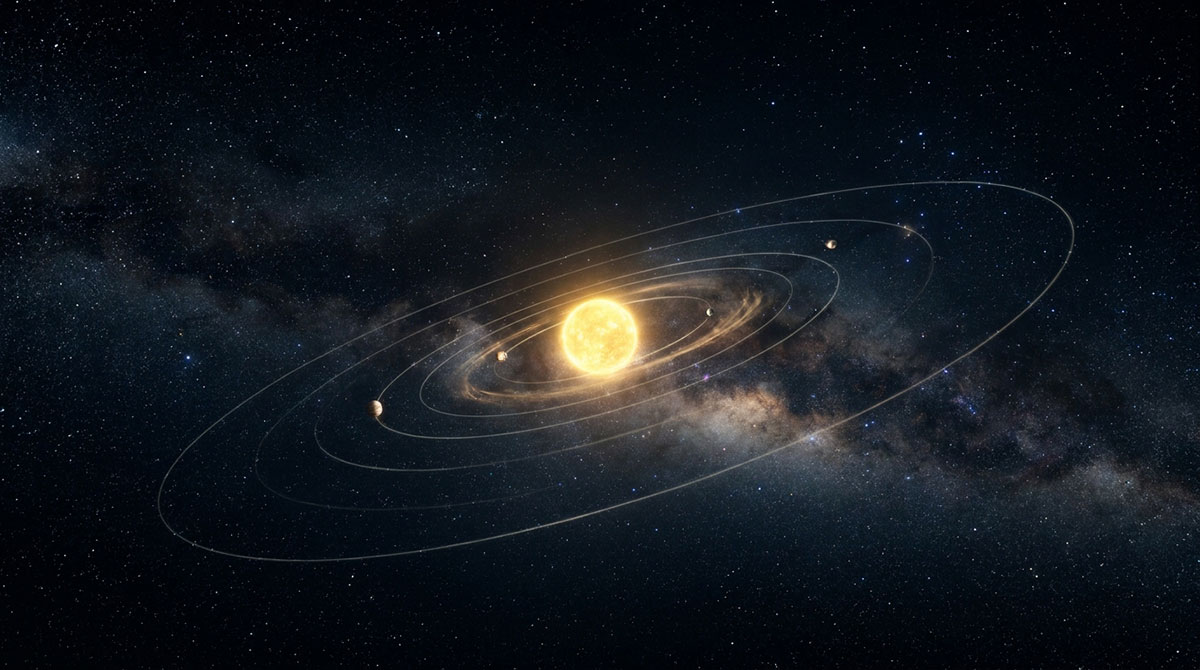
A yellow Sun sits in the center. The planets circle around it in clean rings, each one fixed to an invisible track. Mercury close in. Neptune far out. Everything neat. Everything contained.
It is a useful picture.
It is also incomplete.
The Sun was never standing still.
It is moving through the Milky Way with the planets traveling along with it. The solar system is not a clock laid flat on a table. It is a moving system inside a moving galaxy.
That changes the picture immediately.
Earth is not returning to the same place again and again. It is orbiting the Sun while the Sun carries the entire system through a larger galactic path.
The journey was larger.
The Fixed Sun Problem
There is nothing wrong with simplifying a model.
Every map leaves something out. A subway map does not show the city in perfect proportion. A classroom diagram has one job: make the first pattern visible.
The first pattern is planetary orbit.
But once that model becomes the whole picture, it hides the next one.
The planets orbit the Sun, but the Sun also orbits the center of the Milky Way. Estimates vary depending on measurement method and reference frame, but the Sun travels through the galaxy at roughly hundreds of kilometers per second. One full orbit around the Milky Way takes hundreds of millions of years.
That is not a small correction.
It means the solar system is not merely repeating. It is traveling.
This is why some visualizations show the planets tracing spiral or helical paths behind the Sun. The idea is useful if handled carefully. In a galactic frame, the planets do not simply draw closed circles. Their paths combine local orbit with the Sun’s forward motion.
But the popular “vortex” image can mislead if taken too literally.
The real motion is not a perfect cosmic corkscrew. Orbits are tilted, elliptical, and embedded in a galaxy whose gravity is not a smooth conveyor belt. The image helps break the fixed-Sun illusion, but it should not replace astronomy with a symbol.
It is not the whole map.
Space Is Not Empty
Once the solar system is seen as moving, the next question appears.
What is it moving through?
The easy answer is space. Empty space. A silent blackness between stars.
But interstellar space contains thin gas, dust, magnetic fields, charged particles, and regions of varying density. Compared with air on Earth, it is almost unimaginably sparse. But it is not nothing.
The Sun moves through this interstellar environment like a vessel crossing a vast ocean whose currents are nearly invisible.
Some regions are thinner. Some are denser. Some contain different flows of particles and magnetic structure. The solar system currently moves through a local galactic neighborhood shaped by features such as the Local Bubble and nearby interstellar clouds.
These are not mystical “energies” in the scientific sense. They are physical environments.
Gas. Dust. Fields. Pressure. Motion.
And the Sun responds to them.
The Moving Shield
The Sun does more than shine.
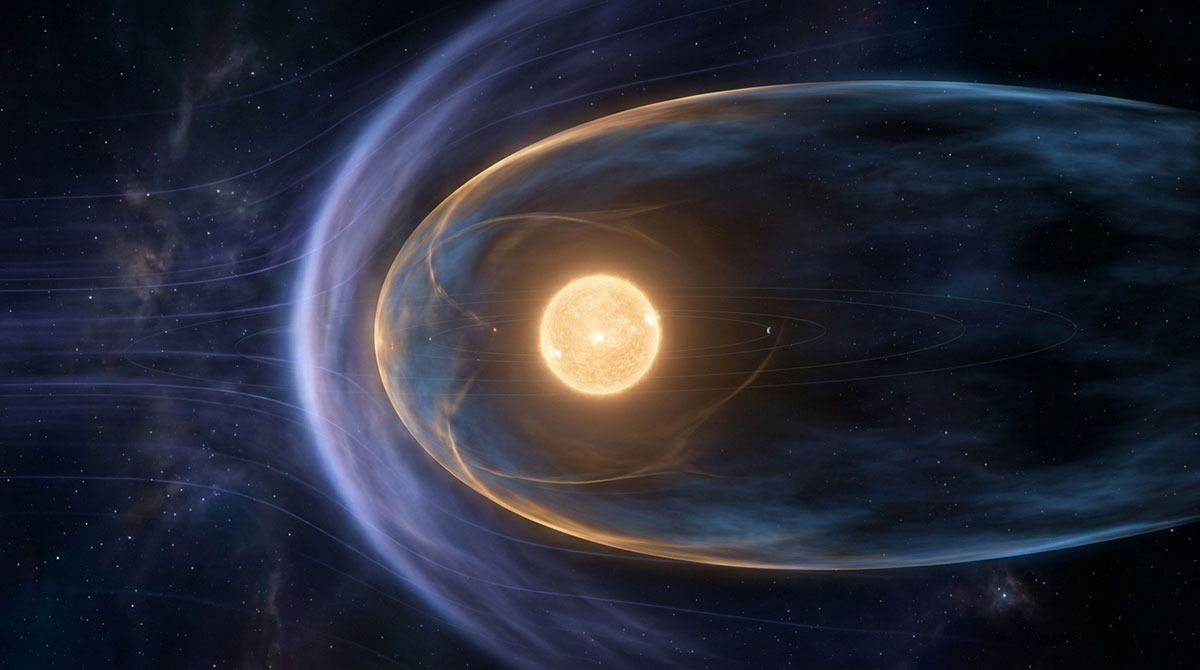
It emits a stream of charged particles known as the solar wind. That wind expands outward and forms a vast bubble around the solar system called the heliosphere.
This bubble is not a hard wall. It is not a glass dome. It is a moving boundary shaped by pressure from inside and outside.
Inside, the solar wind pushes outward.
Outside, the local interstellar medium pushes back.
NASA’s IBEX mission has described this boundary as dynamic, changing over time as the Sun and the surrounding environment interact. The heliosphere stretches, shrinks, and responds. It is less like a fortress and more like a weather system around the solar system.
That matters because the heliosphere helps regulate what reaches the inner solar system from interstellar space.
If the outside environment changes, the shield can change with it.
Suddenly, the galaxy is not a backdrop.
It is terrain.
It moves through conditions.
When the Bubble Shrinks
One of the more striking recent proposals concerns a possible encounter with a dense interstellar cloud.
A 2024 study in Nature Astronomy modeled what may have happened if the Sun passed through a cold, dense cloud in the recent geological past. In that simulation, the heliosphere could have been compressed dramatically, possibly to a distance smaller than Mercury’s orbit at the nose of the bubble.
That is a startling image.
The Sun’s protective boundary, normally extending far beyond the planets, squeezed inward by the surrounding galactic environment.
But caution is essential.
This is a model-based proposal, not a direct photograph of the past. It suggests a possible encounter and a possible compression. It does not prove every downstream effect on Earth’s climate, atmosphere, or biology.
The safe claim is still powerful enough.
Changing interstellar conditions can, in principle, alter the size and shape of the heliosphere. A smaller heliosphere may allow more interstellar material and energetic particles into regions that would otherwise be more shielded.
That changes the scale of the story.
Earth is not sealed away from the galaxy. It is protected by a moving solar boundary that can respond to the environment beyond it.
So is its vulnerability.
Fingerprints in the Crust
If cosmic events touched Earth in the past, where would the evidence remain?
Not in myth first.
In matter.
One of the most important clues is iron-60, a radioactive isotope associated with supernova material. It is not produced on Earth in meaningful amounts. When researchers find traces of iron-60 in deep-sea crusts, sediments, or lunar material, the implication is difficult to ignore.
Something from outside the solar system arrived here.
Studies have reported iron-60 signals in marine archives from the last few million years, often interpreted as evidence of nearby supernova debris reaching Earth. Other isotopes, including plutonium-244, are sometimes discussed in the same broader context of recent astrophysical material delivery.
The distinction matters.
The isotope evidence supports the idea that Earth has received material from cosmic events. It does not automatically prove a specific climate shift. It does not turn every geological change into an astronomical cause.
But it does show that the boundary between Earth history and galactic history is not absolute.
Dust from dying stars can enter the archive of the planet.
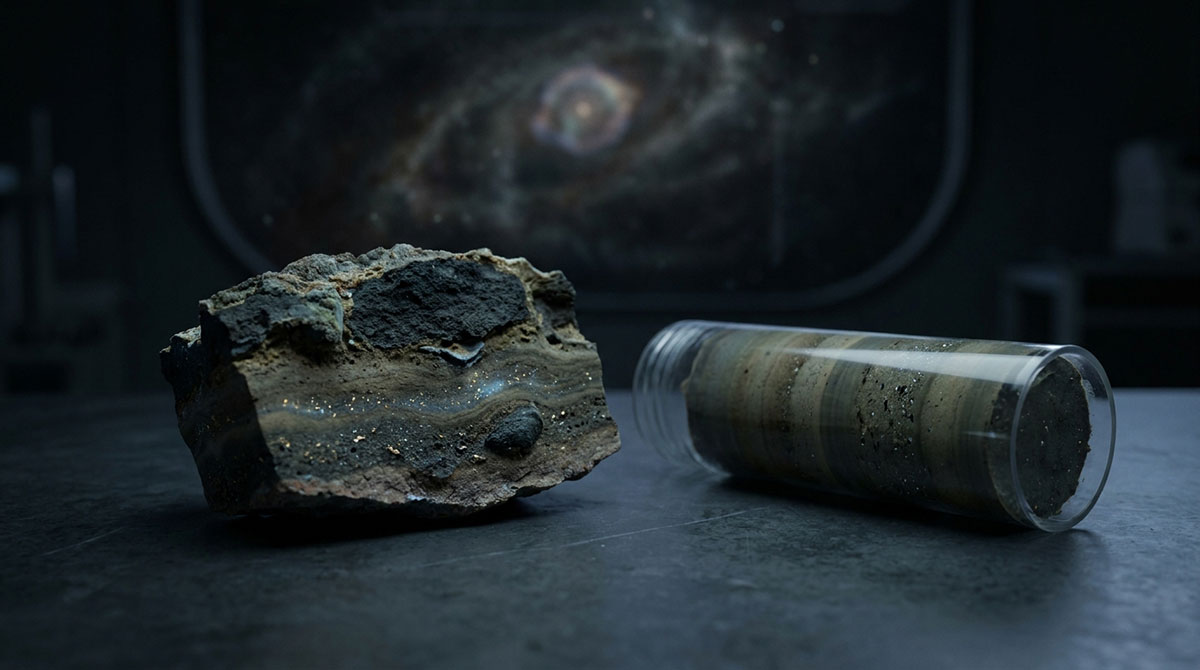
Some of them settle into stone.
A New Galactic Map
For most of human history, the Milky Way was a river of light overhead.
Beautiful. Remote. Almost unreachable.
Modern mapping has changed that.
The European Space Agency’s Gaia mission has measured the positions, distances, and motions of vast numbers of stars, helping astronomers reconstruct the Milky Way as a three-dimensional moving structure rather than a painted ceiling.
That shift is enormous.
With better maps, structures appear that were previously hidden. One of them is the Radcliffe Wave, a large, wavy chain of star-forming gas clouds in the solar neighborhood.
Recent research has suggested that the solar system’s past path may have intersected this structure millions of years ago. The timing has drawn interest because it may overlap with major environmental transitions on Earth.
But overlap is not causation.
The responsible reading is that Gaia-era mapping is making it possible to compare Earth history with the solar system’s changing galactic neighborhood. Some correlations may become meaningful. Others may dissolve under better evidence.
Either way, the old picture is gone.
The galaxy is not merely where the solar system is located.
It is part of the story.
Where Myth Enters
Only after the science is clear can the symbolic layer enter without confusion.
Many ancient cosmologies imagined reality as layered. Heavens, spheres, realms, thresholds, descents, and returns appear across traditions. These were not scientific models in the modern sense. They were maps of meaning.
Gnostic cosmology offers one striking example.
In several Gnostic traditions, Sophia appears as a figure of wisdom associated with descent, rupture, exile, and return. Her story moves through layered realms, from fullness into fragmentation, from distance into matter, from separation toward restoration.
That is not astrophysics.
But it is powerful symbolic language.
Modern astronomy describes a solar system moving through changing galactic environments. Sophia offers another kind of grammar: the language of descent into density, vulnerability inside matter, and the longing for return.
Those two frames should not be collapsed.
Science explains mechanism. Myth explores meaning.
The myth gives resonance.
The Sophia Question
Modern interpreters such as John Lamb Lash have drawn on Gnostic material to present Sophia as a mythic image of Earth’s living intelligence. In that reading, the planet is not merely a rock carrying life, but part of a larger symbolic drama of consciousness, distortion, and correction.
This belongs to mythic interpretation, not scientific evidence.
Astronomy does not need Sophia to explain the heliosphere. Geochemistry does not need Gnostic myth to interpret iron-60. Gaia data does not prove an ancient spiritual cosmology.
But myth does not have to function as proof to have value.
It can provide a symbolic frame for experiences science does not try to answer: vulnerability, belonging, exile, return, and humanity’s relationship to a living cosmos.
The interesting question is not whether Sophia predicted galactic astronomy.
The better question is why layered cosmologies continue to feel meaningful in an age when the galaxy itself is becoming layered, mapped, and dynamic.
What once appeared as spiritual geography now has a physical counterpart: clouds, bubbles, waves, fields, and moving stellar neighborhoods.
Not the same thing.
But close enough to invite reflection.
The Larger Journey
The old model placed the Sun at the center and left it there.
The newer picture is stranger and more alive.
The Sun is moving. The planets move with it. The heliosphere breathes against the interstellar medium. Earth may carry traces of supernova debris in its geological record. Gaia is revealing a galaxy filled with motion, structure, and memory.
This does not mean every ancient symbol was secretly astronomy.
It does not mean every cosmic event shaped human destiny.
But it does mean the solar system is less isolated than the old diagram suggested.
Earth is local. It is also galactic.
The same movement that carries the planets around the Sun carries the Sun through a vast and changing field of conditions. Some may never touch Earth in any obvious way. Others may leave faint signatures in particles, climates, stones, or stories.
At first, the solar system looked like a machine.
Then it became a journey.
We are crossing a galaxy.
That may be the real threshold.
Not the collapse of science into myth.
Not the conversion of myth into data.
But the recognition that both are responding to the same human astonishment: the world is moving, the sky is not still, and the path beneath our feet is larger than it first appeared.
The Sun was never standing still.
And Earth is going with it.